


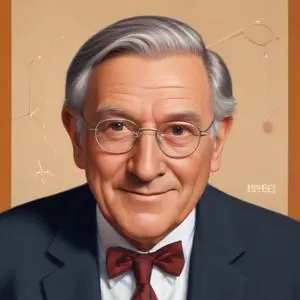
Developed groundbreaking catalysts that enabled efficient and environmentally friendly production of complex molecules, revolutionizing the field of organic chemistry.
Robert H. Grubbs, a renowned American chemist, is best known for his groundbreaking work on olefin metathesis, a fundamental concept in organic chemistry that has revolutionized the way scientists approach chemical reactions. His pioneering research in this field earned him the 2005 Nobel Prize in Chemistry, alongside Richard R. Schrock and Yves Chauvin.
Grubbs was born on February 27, 1942, on a farm in Marshall County, Kentucky. He grew up in a family of modest means, with his mother, Faye, being a schoolteacher and his father, Howard, working as a diesel mechanic. Grubbs's early interest in science led him to pursue a degree in agriculture chemistry at the University of Florida. However, under the guidance of Professor Merle A. Battiste, he soon switched to organic chemistry, fascinated by the intricacies of chemical reactions.
Grubbs earned his B.S. in 1963 and M.S. in 1965 from the University of Florida. He then moved on to Columbia University, where he worked with Professor Ronald Breslow on organometallic compounds, receiving his Ph.D. in 1968.
Grubbs's academic career spanned over four decades, with significant contributions to the field of organometallic chemistry. He began his research on olefin metathesis during his time at Michigan State University, where he was appointed to the faculty in 1969. His work in this area led to the development of new catalysts, enabling the efficient and precise synthesis of complex molecules.
Grubbs's notable achievements include:
Grubbs's work on olefin metathesis has had a profound impact on the understanding of chemical reactions and the development of new materials. His research has enabled the creation of complex molecules with unprecedented precision, paving the way for innovative applications in fields such as medicine, energy, and materials science.
Throughout his career, Grubbs has received numerous awards and honors, including the Nobel Prize in Chemistry, the National Medal of Science, and the ACS Award in Organometallic Chemistry.
Grubbs passed away on December 19, 2021, leaving behind a legacy of groundbreaking research and a new generation of scientists inspired by his work.
Grubbs's contributions to olefin metathesis have far-reaching implications for various industries, including pharmaceuticals, agriculture, and energy. His work has enabled the development of new materials, fuels, and medicines, improving the quality of life for millions of people around the world.
As a testament to his impact, Grubbs's research has been recognized by numerous organizations, including the American Chemical Society and the National Academy of Sciences.
"The most important thing in research is to have a good problem to work on." - Robert H. Grubbs
This quote reflects Grubbs's passion for tackling complex scientific challenges and his dedication to advancing the field of chemistry.
Grubbs's work on olefin metathesis marks a significant milestone in the history of chemistry, building upon the foundations laid by earlier pioneers in the field. His legacy continues to inspire new generations of scientists, driving innovation and discovery in the years to come.
81 Years Old
Developed a catalyst that enables the efficient and environmentally friendly production of pharmaceuticals, fuels, and other valuable chemicals, earning a Nobel Prize in Chemistry in 2005.
95 Years Old
A French chemist and academic who developed the metathesis reaction, a method for rearranging molecules, and was awarded the Nobel Prize in Chemistry in 2005.
86 Years Old
Pioneering chemist and Nobel laureate who developed laser-induced fluorescence, revolutionizing chemical analysis and detection. Known for his groundbreaking work in analytical chemistry and its applications.
70 Years Old
Pioneering biochemist and engineer who directed the design of new biological pathways and developed innovative methods for creating valuable chemicals and fuels. Her groundbreaking work has transformed the field of bioengineering.
