


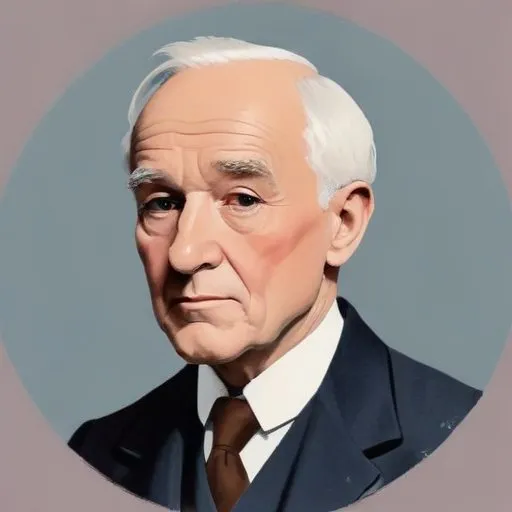
A renowned poet, art critic, and anarchist, he championed modern art and literature, influencing the development of Surrealism and Existentialism. His writings explored the intersection of art, politics, and psychology.
Sir Herbert Edward Read was a luminary of the 20th century, renowned for his groundbreaking contributions to art history, literature, and philosophy. His influential works on the role of art in education, as well as his advocacy for anarchism and existentialism, have left an indelible mark on modern thought.
Read was born on December 4, 1893, at Muscoates Grange, near Nunnington, in the North Riding of Yorkshire, to Herbert Edward Read and his wife Eliza Strickland. His childhood on the family farm instilled in him a deep appreciation for rural life and the natural world. After his father's untimely death, Read's family moved to Leeds, where he attended school and later pursued his studies at the University of Leeds.
The outbreak of World War I interrupted Read's academic pursuits, and he enlisted in the Green Howards in France. During this period, he founded the journal Arts & Letters with Frank Rutter, which became one of the first literary periodicals to publish work by T.S. Eliot. Read's own literary talents were also taking shape, with the self-publication of his first volume of poetry, Songs of Chaos, in 1915.
Read's most notable contributions include his influential volumes on art, such as The Meaning of Art (1931) and Art and Alienation (1967). He also co-founded the Institute of Contemporary Arts and co-edited the British edition of The Collected Works of C.G. Jung with Michael Fordham and Gerhard Adler.
Read was a prominent English anarchist and one of the earliest English writers to engage with existentialism. His philosophical views were shaped by his experiences in World War I and his subsequent disillusionment with modern society. He believed in the importance of individual freedom and the need for art to be liberated from the constraints of traditional institutions.
Read's ideas on art and education have had a profound impact on modern society. His advocacy for the importance of art in education has influenced generations of artists, educators, and thinkers. His work has also inspired countless writers, artists, and musicians, including the likes of E.M. Forster, Aldous Huxley, and Herbert Marcuse.
Read was awarded the Military Cross (MC) and the Distinguished Service Order (DSO) for his bravery during World War I. He was also knighted in 1953 for his services to literature and art.
Herbert Read's life and work serve as a testament to the power of art and ideas to shape our understanding of the world. His contributions to art history, literature, and philosophy continue to inspire new generations of thinkers and creatives. As a visionary who bridged the gaps between art, philosophy, and politics, Read's legacy remains an enduring testament to the transformative potential of human creativity.
Born in 1888
A renowned poet, playwright, and critic who reshaped modern poetry with works like "The Waste Land" and "Old Possum's Book of Practical Cats", influencing literature and art with their unique style.
Born in 1885
A pioneering modernist poet and critic who transformed 20th-century literature with innovative styles and provocative ideas, shaping the course of modern poetry.
Born in 1865
A renowned Irish wordsmith and dramatist, celebrated for his mystical and nationalistic verse that explores the human condition, as well as his contributions to the Irish Literary Revival.
Born in 1885
A pioneering writer of the early 20th century, known for exploring themes of human nature, relationships, and the clash between individual desire and societal expectations through novels like "Sons and Lovers" and "Lady Chatterley's Lover".
Born in 1879
This celebrated author crafted novels and plays that probed the human condition, exploring themes of social class, morality, and personal relationships, with a distinctive wit and insight. Their works continue to captivate audiences with their nuanced portrayals of English society during the early 20th century.
Born in 1882
A pioneering author of modernist literature, known for experimental novels and essays that explored the human experience, blurring the lines between reality and fiction.
Born in 1873
A pioneering modernist writer, credited with influencing 20th-century literature through experimental novels and poetry that explored the human condition. Known for his impressionistic style and complex characters.
Born in 1895
A renowned poet, novelist, and critic, best known for his historical novels, particularly "I, Claudius" and "Count Belisarius", which vividly brought ancient civilizations to life.
