


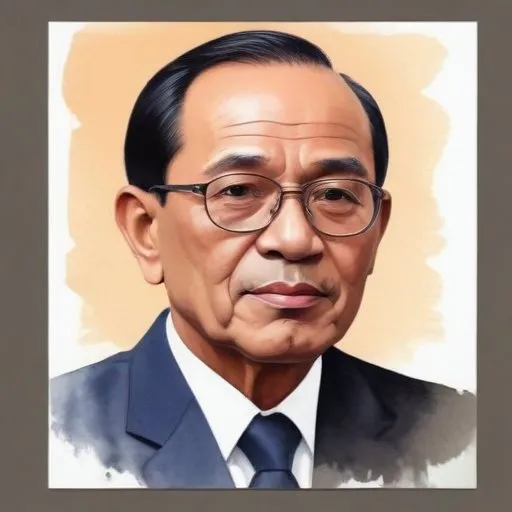
Indonesian scientist, academic, and politician who made significant contributions to the country's education system and served as the Minister of Education and Culture, known for his efforts to promote education and cultural development.
Herman Johannes is best known for his multifaceted contributions to Indonesia as a professor, scientist, politician, and National Hero. Throughout his life, he served in various capacities, including as the rector of Universitas Gadjah Mada, Coordinator for Higher Education, and Minister for Public Works and Energy.
Johannes was born on May 28, 1912, and graduated from Technische Hogeschool THS in Bandung, West Java. This institution later became the embryo of Gadjah Mada University, where he would eventually serve as rector.
Johannes' research focused on rural technology, particularly the development of alternative fuels. He invented a charcoal stove designed for the poor, which used biomass charcoal briquettes for fuel. He also explored the possibility of turning agricultural waste into fuel.
In the 1940s, Johannes was involved in the military, serving as the head of the Indonesian Army Arsenal Laboratory during the independence war against Dutch occupation. His laboratory produced explosives such as smoke bombs and hand grenades, which were used by Indonesian guerrillas to sabotage the movement of the Dutch military in Central Java.
Johannes held various political positions, including Coordinator for Higher Education from 1966 to 1979 and member of Indonesia's Presidential Supreme Advisory Council from 1968 to 1978. He also served as the Minister for Public Works and Energy from 1950 to 1951.
Johannes was a member of the Executive Board of UNESCO from 1954 to 1957, where he contributed to global efforts in education, science, and culture.
Johannes received several awards and honors for his service, including the Guerilla Medal in 1958 and the Mahaputra Medal in 1973. In 2009, he was posthumously honored as a National Hero by the Indonesian government.
Johannes married Annie Marie Gilbertine Amalo in 1955, and they had four children together. He passed away on October 17, 1992, due to prostate cancer and was buried at the Universitas Gadjah Mada Cemetery in Sawitsari, Yogyakarta.
Herman Johannes' contributions to Indonesia's development, both in science and politics, have left a lasting impact on the country. His legacy serves as an inspiration to future generations, demonstrating the importance of service, innovation, and dedication to the nation.
Through his multifaceted career, Herman Johannes embodied the spirit of service, innovation, and dedication to Indonesia. His legacy continues to inspire and motivate Indonesians to strive for excellence and contribute to the nation's development.
79 Years Old
First female President of Indonesia, leading the country from 2001 to 2004 and playing a key role in its transition to democracy. She's a symbol of female empowerment in a predominantly Muslim country.
77 Years Old
The first democratically elected President of Indonesia, serving from 2004 to 2014, known for maintaining stability and promoting economic growth during his tenure. He also played a key role in combating terrorism and separatist movements.
65 Years Old
The first Indonesian president from a lower-middle-class background, known for his efforts to boost economic growth and infrastructure development, while also promoting tolerance and pluralism.
79 Years Old
A former Indonesian military commander who played a key role in the country's transition to democracy and later served as a cabinet minister, known for his efforts to reform the military and promote human rights.
