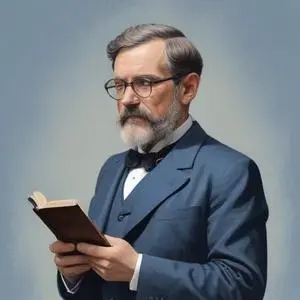
Hermann Ebbinghaus: The Father of Memory Research
A Pioneer in the Experimental Study of Memory
Hermann Ebbinghaus, a German psychologist, is renowned for his groundbreaking work in the experimental study of memory. He is credited with discovering the forgetting curve and the spacing effect, and is considered the first person to describe the learning curve.
Early Life and Education
Ebbinghaus was born on January 24, 1850, in Barmen, Rhine Province, Kingdom of Prussia, to a wealthy merchant family. He was raised in the Lutheran faith and attended the local Gymnasium. At the age of 17, he began studying history and philology at the University of Bonn. However, during his time there, he developed an interest in philosophy. In 1870, his studies were interrupted when he served with the Prussian Army in the Franco-Prussian War.
Academic Pursuits and Career
After completing his military service, Ebbinghaus returned to his studies and received his doctorate in philosophy on August 16, 1873, at the age of 23. During the next three years, he spent time at Halle and Berlin, furthering his education. He then moved to England and France, where he tutored students to support himself. In England, he came across Gustav Fechner's book
Elemente der Psychophysik, which sparked his interest in conducting memory experiments.
Founding the Third Psychological Testing Lab in Germany
In 1879, Ebbinghaus founded the third psychological testing lab in Germany, following
Wilhelm Wundt and Georg Elias Müller. It was here that he began his extensive memory studies, which would later become the foundation of his monumental work,
Über das Gedächtnis. Untersuchungen zur experimentellen Psychologie (On Memory: Investigations in Experimental Psychology). This work, published in 1885, is considered one of the most important contributions to the field of psychology.
Key Contributions and Discoveries
Ebbinghaus' work on memory led to several key discoveries, including:
- The Forgetting Curve: Ebbinghaus demonstrated that memory loss occurs rapidly in the first few hours and days after learning, but slows down over time.
- The Spacing Effect: He showed that information learned in multiple, spaced-out sessions is retained better than information learned in a single, massed session.
- The Learning Curve: Ebbinghaus described the process of learning as a gradual, incremental process, rather than a sudden, all-or-nothing phenomenon.
Legacy and Impact on Psychology
Ebbinghaus' work laid the foundation for modern memory research and has had a profound impact on the field of psychology. His discoveries have been applied in various areas, including education, cognitive psychology, and neuroscience. He is remembered as a pioneer in the experimental study of memory, and his work continues to influence researchers and scholars to this day.
Personal Life and Later Years
Ebbinghaus married Margaret von Wolff in 1883, and they had two sons together. He passed away on February 26, 1909, at the age of 59. Despite his passing, his legacy lives on, and his work remains a testament to his dedication to understanding the human mind.
FAQ
What is Hermann Ebbinghaus known for in the field of psychology?
Hermann Ebbinghaus was a German psychologist who made significant contributions to the field of memory and learning. He is best known for discovering the forgetting curve and the spacing effect, which are still widely used today.
What was Hermann Ebbinghauss approach to studying memory?
Hermann Ebbinghaus used a unique approach to studying memory, focusing on the forgetting curve and the way memories decay over time. He developed methods to measure memory and learning, laying the groundwork for modern psychology.
How did Hermann Ebbinghauss work impact education?
Hermann Ebbinghauss work had a profound impact on education, as it provided insights into how to optimize learning and retention. His findings are still used today to improve teaching methods and educational materials.
What was Hermann Ebbinghauss contribution to the field of pedagogy?
Hermann Ebbinghauss work had a significant impact on the field of pedagogy, as it provided a scientific basis for understanding how people learn. His theories and methods are still studied by educators around the world.
What is Hermann Ebbinghauss legacy in modern psychology?
Hermann Ebbinghauss legacy in modern psychology is immense. He is considered one of the founders of modern psychology, and his work continues to influence research in memory, learning, and education.