


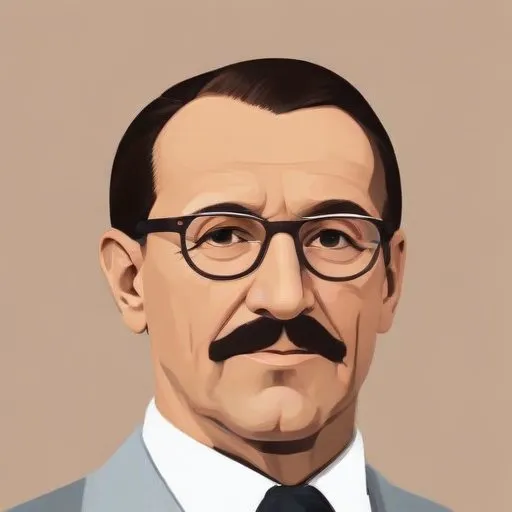
An Austrian engineer and academic who developed innovative traffic management systems, focusing on pedestrian-friendly and environmentally sustainable urban planning. He's known for his "shared space" concept, where pedestrians, cyclists, and cars share the same roads.
Hermann Knoflacher, a renowned Austrian civil engineer, is globally recognized for his pioneering work in promoting sustainable transport and critiquing the dominance of automobiles in urban planning. His innovative concepts, such as the "walkmobile" (Gehzeug), have become a powerful symbol of the need for a fundamental shift in urban transport policy.
Born on September 21, 1940, in Villach, Austria, Knoflacher pursued higher education in civil engineering, geodesy, and mathematics. His academic excellence led him to become a professor at the Vienna University of Technology in 1975, where he eventually headed the Institute for Transport Planning and Technology.
Knoflacher's research has been instrumental in shaping the sustainable transport movement, particularly in Europe. His work has focused on spatial planning, urban planning, and transport planning, emphasizing the need for a more harmonious relationship between cities and transport systems. As a key contributor to the "Sanfte Mobilitt" (gentle mobility) movement, he has inspired a new generation of urban planners and policymakers to rethink their approach to urban transport.
In the 1980s, Knoflacher developed the concept of the walkmobile, a wooden frame that can be worn by pedestrians to illustrate the absurdity of urban transport policy. By occupying the same amount of space as a motorist, the walkmobile highlights the irrationality of prioritizing cars over people in urban planning. This innovative tool has been used in demonstrations and protests, sparking vital discussions about the impact of car dominance on cities.
Knoflacher's work is underpinned by a deep understanding of the intricate relationships between humans, environment, and technology. He has compared the automobile to a virus, highlighting how it has contributed to the erosion of public spaces and the degradation of the environment. By challenging the status quo, Knoflacher encourages us to rethink our values and priorities, promoting a more balanced and sustainable approach to urban development.
Knoflacher's work has had a profound impact on the way we think about urban transport and the role of cars in our cities. His innovative concepts and critiques have inspired a new wave of urban planners, policymakers, and activists to work towards creating more sustainable, people-friendly cities. As we face the challenges of climate change, urbanization, and environmental degradation, Knoflacher's vision for a more harmonious relationship between cities and transport systems is more relevant than ever.
Through his tireless advocacy and innovative ideas, Hermann Knoflacher has left an indelible mark on the world of urban transport and planning. His legacy serves as a powerful reminder of the need for a fundamental shift in our approach to urban development, one that prioritizes people, the environment, and sustainability over the dominance of cars.
Born in 1894
Pioneering mathematician and philosopher who laid the foundations for cybernetics, exploring the intersection of humans, machines, and society. His work has far-reaching implications for artificial intelligence, automation, and modern technology.
Born in 1903
Pioneering mathematician and physicist who developed the concept of the modern computer architecture and made significant contributions to quantum mechanics and game theory. His work laid the foundation for modern computing and artificial intelligence.
Born in 1906
A groundbreaking logician and philosopher who shook the foundations of mathematics with his incompleteness theorems, proving that no formal system can be both complete and consistent.
Born in 1912
Pioneering mathematician and computer scientist who cracked the German Enigma code during WWII and laid the foundations for modern computer science and artificial intelligence.
Born in 1926
Austrian priest and philosopher who critiqued modern society, arguing that many institutions, including education and healthcare, have become counterproductive and stifle individual freedom. He's known for his radical ideas on deschooling and decolonizing knowledge.
Born in 1900
A German psychologist and sociologist who developed the concept of "social character" and explored the relationship between psychology and society, known for his humanistic and socialist approach.
