


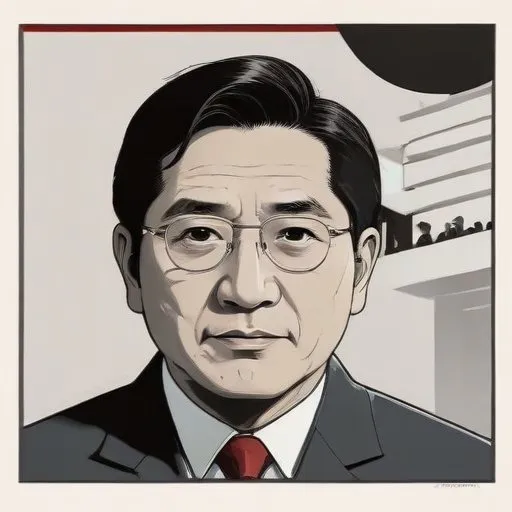
A Japanese lawyer and politician who served as the 35th Prime Minister of Japan, known for his conservative and nationalist views, and his role in shaping Japan's pre-WWII politics.
Hiranuma Kiichir was a prominent Japanese lawyer and politician who served as the Prime Minister of Japan in 1939, leaving an indelible mark on the country's history. As a strong advocate for Japanese culture and values, he played a significant role in shaping the nation's political landscape during a tumultuous period.
Born on September 28, 1867, in what is now Tsuyama City, Okayama Prefecture, Hiranuma was the son of a low-ranking samurai from the Tsuyama Domain of Mimasaka Province. His upbringing and early education were steeped in bushido and the study of Chinese classics, which laid the foundation for his strong sense of Japanese identity and cultural values.
After graduating with a degree in English law from Tokyo Imperial University in 1888, Hiranuma reacted against the rapid westernization and disregard for Japanese culture common at that time. Throughout his life, his political principles would be substantially based on Confucianism as taught by the Mito School, which emphasized the importance of the moral bond between the nation and the Emperor as a sacred ruler.
Hiranuma established a reputation as a strong opponent of government corruption during his time at the Ministry of Justice, where he successfully handled a number of high-profile cases. He served as director of the Tokyo High Court, public prosecutor of the Supreme Court of Japan, and Director of the Civil and Criminal Affairs Bureau, earning a reputation as a fair and just lawyer.
Hiranuma's political career was marked by several significant milestones, including his appointment as Minister of Justice under Prime Minister Gonnohyoe Yamamoto and later as a privy counsellor. In 1939, he became the Prime Minister of Japan, although his tenure was short-lived due to his resignation later that same year.
He later returned to cabinet under Fumimaro Konoe, where he continued to advocate for Japanese values and interests. However, his role in World War II led to his sentencing to life imprisonment by the International Military Tribunal for the Far East after Japan's surrender.
Hiranuma's political principles were deeply rooted in Confucianism, which emphasized the importance of social hierarchy, morality, and loyalty. He believed that Japan possessed a unique essence, the kokutai, characterized by the moral bond between the nation and the Emperor as a sacred ruler. Foreign influences, unless properly adapted, he viewed as threats to the kokutai.
Hiranuma Kiichir's legacy is complex and multifaceted, reflecting both his contributions to Japanese politics and his role in World War II. While his strong sense of Japanese identity and cultural values shaped his political career, his involvement in the war led to his downfall. Despite this, his impact on Japanese politics and society remains significant, serving as a testament to the power of conviction and principle in shaping the course of history.
Born in 1901
The Japanese emperor who ruled from 1926 to 1989, leading the country through World War II and its post-war reconstruction, and is known for his symbolic role in Japanese politics and culture. He is also remembered for his rare public apology for Japan's wartime atrocities.
Born in 1872
A Japanese politician and diplomat who served as Prime Minister of Japan from 1924 to 1927, known for his efforts to improve relations with the West and promote international cooperation.
Born in 1891
A Japanese politician who served as Prime Minister during World War II, known for his role in leading Japan into the war and his attempts to negotiate a peace settlement. He is also infamous for his involvement in the Nanjing Massacre.
