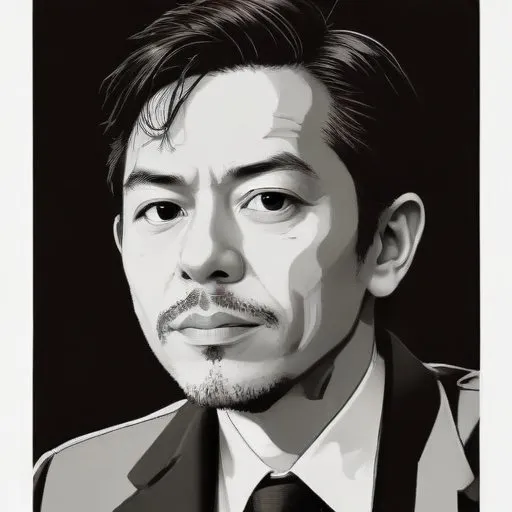
Hiroshi Teshigahara: The Visionary filmmaker of Japan's New Wave Era
A Master of Avant-Garde Storytelling
Hiroshi Teshigahara is renowned for his thought-provoking and visually stunning films that catapulted him to fame in the 1960s. He is best known for his 1964 masterpiece,
Woman in the Dunes, which earned him an Academy Award nomination for Best Director, making him the first person of Asian descent to receive this honor.
Early Life and Inspiration
Born on January 28, 1927, in Tokyo, Japan, Teshigahara was the son of Sofu Teshigahara, the founder and grand master of the Sōgetsu school of ikebana. This artistic upbringing had a profound impact on his creative vision, as he went on to explore various art forms, including calligraphy, pottery, painting, opera, and ikebana. In 1950, he graduated from the Tokyo National University of Fine Arts and Music, where he began experimenting with documentary filmmaking.
Collaborations and Breakthroughs
Teshigahara's directorial debut,
Pitfall (1962), was a collaborative effort with author Kōbō Abe and musician
Toru Takemitsu. This film won the NHK New Directors award, setting the tone for hisfuture collaborations with Abe and Takemitsu. Throughout the 1960s, he continued to push the boundaries of cinematic storytelling, experimenting with unconventional narrative structures and themes.
Woman in the Dunes: A Cinematic Masterpiece
Teshigahara's magnum opus,
Woman in the Dunes (1964), is a surreal and haunting tale of a woman trapped in a mysterious village, where she is forced to collect sand. This film not only earned him an Academy Award nomination but also won the Special Jury Prize at the Cannes Film Festival. Initially, the film was 147 minutes long, but Teshigahara edited it down to 124 minutes for its international release.
Exploring the Human Condition
Teshigahara's films often explored the complexities of human relationships, identity, and the search for meaning. His 1966 film,
The Face of Another, is a gripping tale of a man who undergoes facial reconstruction surgery, only to lose his sense of self. In
Summer Soldiers (1972), he collaborated with Japanese researcher and translator John Nathan to tell the story of American deserters living on the fringes of Japanese society during the Vietnam War.
A Legacy of Innovation
Hiroshi Teshigahara's contributions to Japanese cinema are immeasurable. He was a true pioneer, who challenged conventional norms and inspired a generation of filmmakers. Through his work, he continues to inspire artists, writers, and filmmakers to push the boundaries of their creativity.
Awards and Honors
- Academy Award nomination for Best Director for Woman in the Dunes (1964)
- Special Jury Prize at the Cannes Film Festival for Woman in the Dunes (1964)
- NHK New Directors award for Pitfall (1962)
Personal Milestones and Key Life Events
- Founded the Teshigahara Production Company in 1963
- Received the Japanese Medal of Honor with Purple Ribbon in 1993
- Passed away on April 14, 2001, leaving behind a legacy of innovation and creativity
Influence on Modern Society
Teshigahara's films continue to inspire artists, writers, and filmmakers to experiment with unconventional narrative structures and themes. His work has influenced a wide range of artists, from filmmakers like
Akira Kurosawa to musicians like
Ryuichi Sakamoto. His legacy serves as a testament to the power of innovation and creative vision.
FAQ
What kind of films did Hiroshi Teshigahara direct?
Hiroshi Teshigahara directed a wide range of films, including dramas, thrillers, and documentaries. He was known for his unique visual style and exploration of themes such as identity, morality, and social justice.
What is Hiroshi Teshigaharas most famous film?
Hiroshi Teshigaharas most famous film is probably The Face of Another (1966), which won the Grand Prix at the Berlin International Film Festival.
What awards did Hiroshi Teshigahara win for his films?
Hiroshi Teshigahara won several awards for his films, including the Golden Lion at the Venice Film Festival and the Japan Academy Prize for Director of the Year.
What was Hiroshi Teshigaharas early career like?
Hiroshi Teshigahara began his career as an assistant director to his father, a prominent Japanese film director. He eventually transitioned to directing his own films, which were often experimental and avant-garde.
What is Hiroshi Teshigaharas legacy in Japanese cinema?
Hiroshi Teshigaharas legacy in Japanese cinema is that of a visionary director who pushed the boundaries of Japanese filmmaking and explored new ways of storytelling and visual expression.