


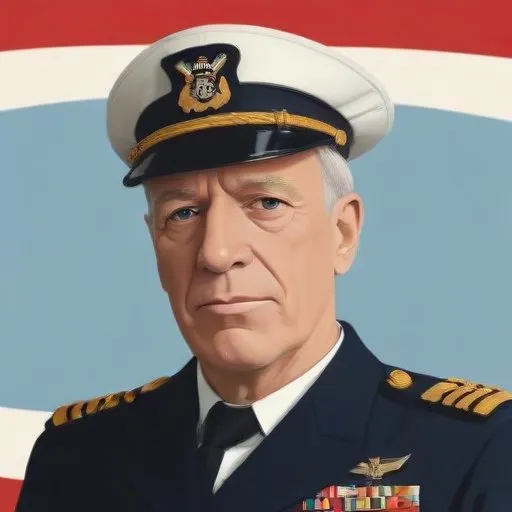
An American naval officer who served as the Superintendent of the United States Naval Academy and played a key role in the development of the Navy's submarine force. He's also known for his contributions to the Navy's early adoption of nuclear power.
Homer N. Wallin, a vice admiral in the United States Navy, is renowned for his remarkable salvage of ships sunk in the devastating attack on Pearl Harbor. This heroic feat not only saved lives but also restored hope and momentum to the American war effort during World War II.
Born on December 6, 1893, in Washburn, North Dakota, Wallin's journey began with a brief attendance at the University of North Dakota and a year in the state National Guard. He was then appointed to the U.S. Naval Academy in 1913, where he graduated in March 1917 and was commissioned as an Ensign.
During World War I, Wallin served in the battleship New Jersey (BB-16), and later, in September 1918, he was transferred to the navy's Construction Corps and sent to the Massachusetts Institute of Technology for postgraduate education in naval architecture. He received his Master of Science degree in 1921 and went on to serve in various capacities, including at the New York Navy Yard, the Bureau of Construction and Repair, and the Mare Island and Philadelphia Navy Yards.
In 1941, Captain Wallin became material officer for commander, Battle Force, U.S. Pacific Fleet, and was serving in that position when Japan attacked Pearl Harbor on December 7, 1941. Early in the following year, he was placed in charge of the Pearl Harbor Navy Yards Salvage Division, where he directed the monumental task of salvaging three sunken battleships. This incredible feat not only restored the navy's capabilities but also boosted the morale of the American people.
Wallin met and married his wife Elizabeth, with whom he had two children, son Homer Norman, Jr., and daughter Susan Ann. A true family man, Wallin's love for his family and country drove him to achieve greatness. Throughout his illustrious career, he received numerous awards and honors, solidifying his place as a hero of Pearl Harbor.
Wallin's bravery, determination, and leadership during the Pearl Harbor salvage effort have inspired countless Americans, particularly those serving in the armed forces. His legacy serves as a beacon of hope, reminding us that even in the darkest times, humanity can come together to achieve the impossible.
Homer N. Wallin's remarkable story serves as a testament to the power of human resilience, determination, and leadership. His unwavering commitment to his country and people has left an indelible mark on American history, inspiring generations to come.
Born in 1885
Led the U.S. Pacific Fleet to victory in World War II, playing a crucial role in defeating Japan and ending the war. He was a highly respected and decorated naval leader.
Born in 1882
A five-star admiral who played a crucial role in the Allied victory in World War II, leading the US Navy to several key victories in the Pacific Theater. He's also known for his bold and unconventional tactics.
Born in 1886
A highly decorated naval officer who played a crucial role in several key battles in World War II, including the Battle of Midway, and later served as a diplomat.
Born in 1884
Led the Imperial Japanese Navy during World War II, masterminding the surprise attack on Pearl Harbor, and later became a symbol of Japanese military power and strategy.
Born in 1882
American admiral who led the U.S. Pacific Fleet during the Japanese attack on Pearl Harbor, and was subsequently relieved of his command and forced into retirement. He remains a controversial figure in American history.
Born in 1888
Led the Allied naval forces in the Pacific during World War II, playing a crucial role in several key battles, including the Battle of the Coral Sea and the Battle of Midway. He was a highly respected and influential naval strategist.
