


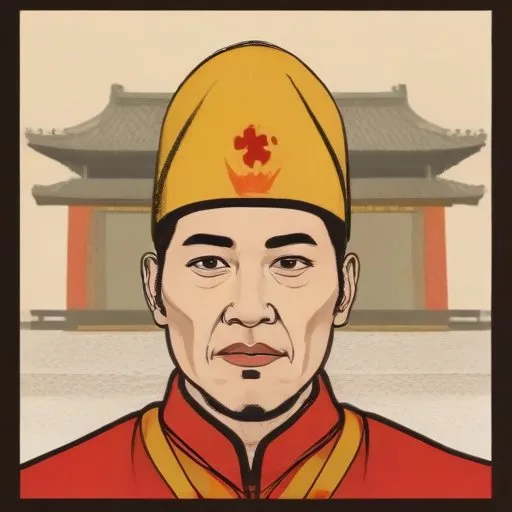
The fourth emperor of the Ming dynasty, he's known for his brief but significant reign, which saw the restoration of the imperial examination system and the rebuilding of the capital city. He's also famous for his humble and frugal lifestyle.
The Hongxi Emperor, known for his vastly bright reign, was the fourth emperor of the Ming dynasty, ruling from 1424 to 1425. During his short but impactful reign, he made significant reforms, restoring civil government and improving finances, earning him a place in history as one of the most notable emperors of the Ming dynasty.
Born on August 16, 1378, Zhu Gaochi, the Hongxi Emperor, was the eldest son of the Yongle Emperor and Empress Renxiaowen. He was educated by prominent Confucian tutors, which laid the foundation for his later reforms. He often acted as regent in Nanjing or Beijing during his father's northern military campaigns, gaining valuable experience in governance.
Upon his ascension to the throne, the Hongxi Emperor cancelled the expensive maritime expeditions of Zheng He, restoring the focus on civil government. He reinstated disgraced Confucian officials, such as Xia Yuanji, and reorganized the administration to give high ranks to his close advisors. He also improved finances by canceling requisitions for lumber, gold, and silver, and remitted taxes to encourage vagrant farmers to return home.
The Hongxi Emperor's reign was marked by significant personal milestones, including his enthronement in September 1424 and his decision to move the capital back to Nanjing from Beijing. He also showed prowess in archery, a skill that reflected his military background.
The Hongxi Emperor's reign marked a significant shift in the Ming dynasty's priorities, from military expansion to civil government and welfare. His reforms and policies had a lasting impact on the dynasty, earning him a place in history as one of the most notable emperors of the Ming dynasty.
In conclusion, the Hongxi Emperor's vastly bright legacy continues to inspire and educate us about the importance of prioritizing the welfare of the people and the significance of civil government in a nation's development.
Born in 1130
A leading figure in Confucianism, he synthesized Confucian classics into a coherent philosophical system, influencing East Asian thought for centuries. His teachings emphasized moral cultivation and self-reflection.
Born in 1328
Founded the Ming dynasty, reunifying China after a century of fragmentation, and established a strong, centralized government. He's also known for his brutal suppression of opposition and his autocratic rule.
Born in 1360
Third emperor of the Ming dynasty, he oversaw the construction of the Forbidden City and sponsored the maritime explorer Zheng He's voyages, expanding China's influence globally.
Born in 1472
A 16th-century Chinese philosopher who merged Confucianism with Taoist and Buddhist elements, emphasizing individual moral intuition and the unity of knowledge and action.
