


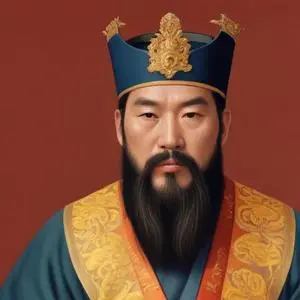
Founded the Ming dynasty, reunifying China after a century of fragmentation, and established a strong, centralized government. He's also known for his brutal suppression of opposition and his autocratic rule.
The Hongwu Emperor, also known as Zhu Yuanzhang, is revered as the founding emperor of the Ming dynasty, reigning from 1368 to 1398. He is credited with unifying China, ending the Mongol-led Yuan dynasty, and establishing a new era of peace and prosperity.
In the tumultuous 14th century, China was plagued by famine, plague, and peasant revolts. Amidst this chaos, Zhu Yuanzhang emerged as a charismatic leader, commanding the Red Turban Rebellion. He successfully conquered China proper, forcing the remnant Yuan court to retreat to the Mongolian Plateau. In 1368, he claimed the Mandate of Heaven and established the Ming dynasty, occupying the Yuan capital of Khanbaliq (present-day Beijing) with his army.
Trusting only his family, Zhu Yuanzhang appointed his many sons as feudal princes along the northern marches and the Yangtze valley. However, his succession plans were marred by controversy. After outliving his eldest son, Zhu Biao, he enthroned Zhu Biao's son via a series of instructions, which ultimately failed, leading to the Jingnan Rebellion.
The Hongwu Emperor's reign is notable for its unprecedented tolerance of minorities and religions. He ordered the renovation and construction of many mosques in Xian and Nanjing, and even wrote the Hundred-word Eulogy praising Islam. Additionally, he introduced radical political reforms, abolishing the position of chancellor, reducing the role of court eunuchs, and adopting draconian measures to address corruption. He also established the Embroidered Uniform Guard, a feared secret police organization in imperial China.
In the 1380s and 1390s, a series of purges were launched to eliminate high-ranking officials and generals, resulting in the execution of tens of thousands. This period was marked by cruelty and brutality, tarnishing the emperor's legacy.
Despite the controversies, the Hongwu Emperor's reign laid the foundation for the Ming dynasty's prosperity and cultural flowering. He established a strong, centralized government, promoted Confucianism, and nurtured a golden age of art, literature, and trade. His impact on modern Chinese society is still felt, with his legacy continuing to inspire and influence contemporary China.
Born on October 21, 1328, Zhu Yuanzhang rose from humble beginnings to become one of China's most revered leaders. His personal name was Zhu Yuanzhang, with the courtesy name Guorui. He died on June 24, 1398, leaving behind a lasting legacy.
In conclusion, the Hongwu Emperor's remarkable life and reign continue to captivate historians and inspire generations. His vision, leadership, and reforms transformed China, cementing his place as one of the most important figures in Chinese history.
Born in 1130
A leading figure in Confucianism, he synthesized Confucian classics into a coherent philosophical system, influencing East Asian thought for centuries. His teachings emphasized moral cultivation and self-reflection.
Born in 1355
Eldest son of the Ming dynasty's founder, known for his brief reign as crown prince and his artistic talents, particularly in calligraphy and poetry.
Born in 1360
Third emperor of the Ming dynasty, he oversaw the construction of the Forbidden City and sponsored the maritime explorer Zheng He's voyages, expanding China's influence globally.
Born in 1378
The fourth emperor of the Ming dynasty, he's known for his brief but significant reign, which saw the restoration of the imperial examination system and the rebuilding of the capital city. He's also famous for his humble and frugal lifestyle.
Born in 1399
The fifth emperor of the Ming dynasty, ruling from 1425 to 1435, is renowned for his military campaigns, reunifying China and establishing a strong, centralized government. He also encouraged cultural and artistic developments.
