


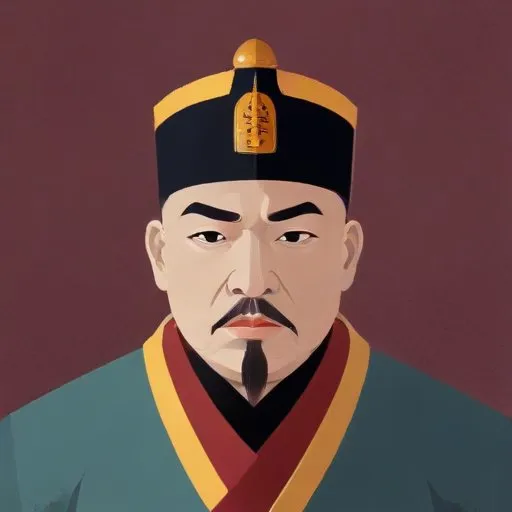
The fifth emperor of the Ming dynasty, ruling from 1425 to 1435, is renowned for his military campaigns, reunifying China and establishing a strong, centralized government. He also encouraged cultural and artistic developments.
The Xuande Emperor, also known as Zhu Zhanji, is most renowned for his impressive reign as the fifth emperor of the Ming dynasty from 1425 to 1435, marked by his passion for poetry, literature, and the arts, as well as his military prowess and strategic leadership.
Zhu Zhanji was born on March 16, 1399, to Zhu Gaochi, who would later become the Hongxi Emperor. From a young age, he demonstrated a keen interest in poetry and literature, and was also skilled in painting and warfare. This unique combination of artistic and martial talents would later characterize his rule as emperor.
In 1425, following his father's brief reign, Zhu Zhanji ascended to the throne as the emperor of the Ming dynasty. One of his first decisions was to reverse his father's plan to relocate the capital from Beijing to Nanjing, a move that would have significant implications for the dynasty's power and influence.
During the early years of his reign, the Xuande Emperor faced a series of challenges, including a prolonged war in Vietnam that ultimately ended in Ming defeat and Vietnam's independence. However, he successfully led his army against his uncle, Zhu Gaoxu, who had rebelled against him, and established peaceful relations with Southeast Asian nations, including Korea and Japan.
The Xuande Emperor sought to promote order and efficiency within his government through a series of reforms, including purges in the Censorate and military service reforms in 1428. However, these efforts were only partially successful, and eunuchs began to gain increased influence, particularly in the secret police.
The Xuande Emperor's government also attempted to promote the use of paper money and discourage the use of coins and precious metals. Although this effort was ultimately unsuccessful, his reign marked a significant period of cultural and economic growth, and he is still remembered as a patron of the arts and a skilled military leader.
Although no direct quotes from the Xuande Emperor have been recorded, his passion for poetry and literature is reflected in the many literary works produced during his reign, including the Xuande Emperor's Anthology of Poetry.
The Xuande Emperor's reign marked a significant period of growth and cultural development in the Ming dynasty. His legacy as a patron of the arts and a skilled military leader continues to be celebrated in Chinese history, and his reign serves as a testament to the enduring power and influence of the Ming dynasty.
The Xuande Emperor's reign had a lasting impact on Chinese culture and society, and his legacy continues to influence modern Chinese art, literature, and politics. His military campaigns and strategic leadership also serve as a model for effective governance and diplomacy.
Born in 1378
The fourth emperor of the Ming dynasty, he's known for his brief but significant reign, which saw the restoration of the imperial examination system and the rebuilding of the capital city. He's also famous for his humble and frugal lifestyle.
Born in 1360
Third emperor of the Ming dynasty, he oversaw the construction of the Forbidden City and sponsored the maritime explorer Zheng He's voyages, expanding China's influence globally.
Born in 1428
The seventh emperor of the Ming dynasty, known for his brief reign and attempts to reform the government and military, but ultimately being overthrown by his brother.
Born in 1447
Ruler of the Ming dynasty from 1464 to 1487, known for his efforts to strengthen the economy and military, as well as his infamous purge of eunuchs.
Born in 1491
Ruling China from 1505 to 1521, he's remembered for his eunuch-dominated government, lavish spending, and military campaigns that expanded the empire's borders. His reign was marked by extravagance and external conflicts.
Born in 1507
Ruling China from 1521 to 1566, this emperor oversaw a period of cultural and economic growth, while also being known for his tyrannical behavior and persecution of officials.
