


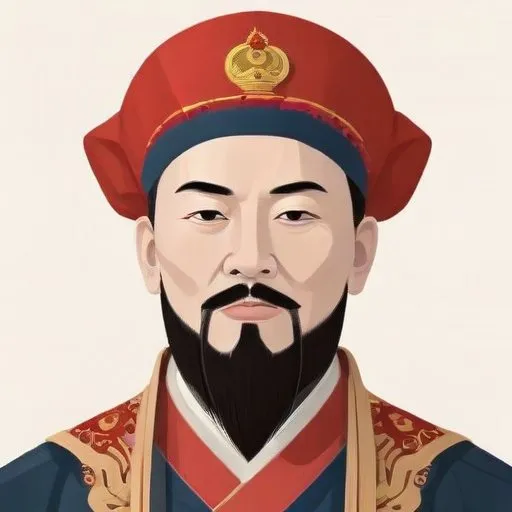
The seventh emperor of the Ming dynasty, known for his brief reign and attempts to reform the government and military, but ultimately being overthrown by his brother.
The Jingtai Emperor, also known as Zhu Qiyu, is remembered for his pivotal role in restoring the Ming dynasty's infrastructure and economy during his reign from 1449 to 1457. He is particularly notable for his efforts in repairing the Grand Canal and the Yellow River's dam system, which led to a period of economic prosperity and strengthened the country's foundations.
Zhu Qiyu was born on September 21, 1428, and was the younger brother of Emperor Yingzong. Following the defeat of the Ming army and the capture of Yingzong by the Mongols in the Battle of Tumu Fortress in 1449, Zhu Qiyu was elevated to the throne to maintain stability and continuity in the government.
During his reign, the Jingtai Emperor worked closely with prominent minister Yu Qian to implement numerous infrastructure projects. These initiatives included the repair of the Grand Canal, which facilitated trade and commerce, and the reinforcement of the Yellow River's dam system, which prevented devastating floods and ensured agricultural productivity.
These efforts led to a period of economic growth and revitalization, bolstering the Ming dynasty's strength and stability. The Jingtai Emperor's reign is often referred to as the "Jingtai era," symbolizing his commitment to restoring the dynasty's grandeur.
In 1457, the Jingtai Emperor fell ill and his death was imminent. Without a designated heir, Emperor Yingzong seized the opportunity to stage a palace coup and reclaim the throne. The Jingtai Emperor died a month later, in March 1457.
Despite his relatively short reign, the Jingtai Emperor's legacy is marked by his significant contributions to the Ming dynasty's infrastructure and economy. His efforts to restore the country's foundations paved the way for future emperors to build upon.
The Jingtai Emperor's personal life is marked by tragedy, including the death of his son and crown prince in unclear circumstances, possibly due to poisoning. Despite this, he maintained a strong relationship with his brother, Emperor Yingzong, and worked to maintain stability in the government during this tumultuous period.
In conclusion, the Jingtai Emperor's reign was marked by his dedication to restoring the Ming dynasty's infrastructure and economy. His efforts to repair the Grand Canal and the Yellow River's dam system led to a period of economic prosperity, solidifying his place in Chinese history as a pivotal figure in the Ming dynasty.
Born in 1378
The fourth emperor of the Ming dynasty, he's known for his brief but significant reign, which saw the restoration of the imperial examination system and the rebuilding of the capital city. He's also famous for his humble and frugal lifestyle.
Born in 1399
The fifth emperor of the Ming dynasty, ruling from 1425 to 1435, is renowned for his military campaigns, reunifying China and establishing a strong, centralized government. He also encouraged cultural and artistic developments.
Born in 1491
Ruling China from 1505 to 1521, he's remembered for his eunuch-dominated government, lavish spending, and military campaigns that expanded the empire's borders. His reign was marked by extravagance and external conflicts.
Born in 1507
Ruling China from 1521 to 1566, this emperor oversaw a period of cultural and economic growth, while also being known for his tyrannical behavior and persecution of officials.
