


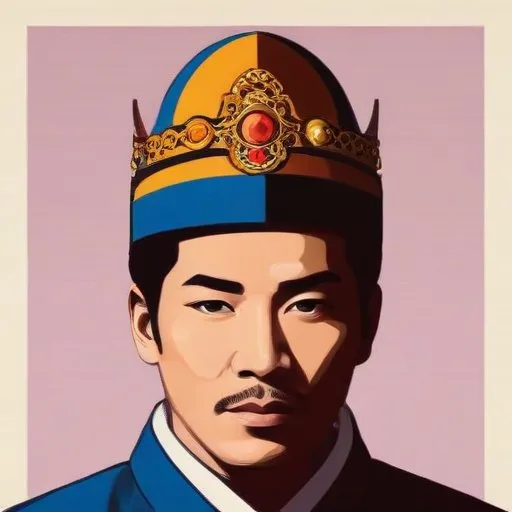
Eldest son of the Ming dynasty's founder, known for his brief reign as crown prince and his artistic talents, particularly in calligraphy and poetry.
Zhu Biao, the eldest son of the Hongwu Emperor, is remembered as the crown prince of the Ming dynasty who met an untimely demise, sparking a crisis in the dynasty's first succession. He is known for his softhearted nature and his deep appreciation for traditional Chinese culture, which set him apart from his father and brother.
Born on October 10, 1355, Zhu Biao was kept away from the front lines of his father's rebellion against the Yuan dynasty. Instead, he was provided with the most esteemed Confucian scholars of his time as tutors, ensuring he received a rich education in traditional Chinese culture and values.
Zhu Biao is remembered for his compassion and empathy towards others, often questioning his father's harsh decisions. According to the official History of Ming, he once asked his father why so many of the ministers and generals who had aided him in forming the Ming Empire were being rewarded with death or banishment. His father replied that they were like thorns on a vine, and he was kindly removing them before passing it on to his son.
Zhu Biao was involved in a survey of Xian and Luoyang as potential capitals for the dynasty, showcasing his deep appreciation for traditional Chinese culture. His love for culture was passed down to his son, the Jianwen Emperor, who shared his father's passion for the arts.
Zhu Biao fell ill and died in 1392 at the age of 36, leaving a power vacuum that his brother Zhu Di would eventually fill. He was posthumously honored with the title Crown Prince Yiwen by his father and Xingzong, Emperor Xiaokang by his son. However, after Zhu Di usurped the throne, he was posthumously demoted back to Crown Prince Yiwen. During the Southern Ming, he was again posthumously restored as Xingzong and Emperor Xiaokang.
Zhu Biao followed the practice of including a generation name into the personal names of his other children. The names followed a generation poem, which was:
Zhu Biao's legacy may have been cut short, but his impact on the Ming dynasty and Chinese culture as a whole is still felt today. His story serves as a reminder of the complexities of power and the importance of compassion in leadership.
Zhu Biao's legacy continues to influence modern Chinese society, with his love for traditional culture and his softhearted nature serving as an inspiration to many. His story has been immortalized in literature, art, and film, ensuring his memory lives on for generations to come.
Zhu Biao's life may have been short-lived, but his impact on Chinese history and culture is immeasurable. He will always be remembered as the crown prince who brought a touch of humanity to the imperial court, and his legacy will continue to inspire future generations.
Born in 1130
A leading figure in Confucianism, he synthesized Confucian classics into a coherent philosophical system, influencing East Asian thought for centuries. His teachings emphasized moral cultivation and self-reflection.
Born in 1378
The fourth emperor of the Ming dynasty, he's known for his brief but significant reign, which saw the restoration of the imperial examination system and the rebuilding of the capital city. He's also famous for his humble and frugal lifestyle.
