


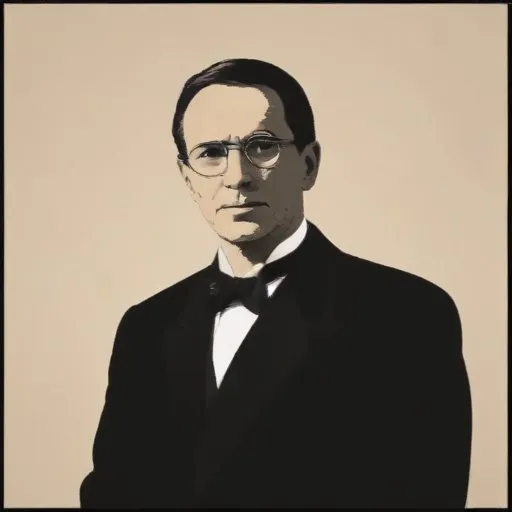
A renowned composer, conductor, and educator who made significant contributions to American classical music, particularly through his Romantic-style symphonies and leadership of the Eastman School of Music.
Renowned composer, conductor, educator, and champion of American classical music, Howard Hanson is best known for his triumphant Symphony No. 4, which earned him the prestigious Pulitzer Prize in 1944. As the director of the Eastman School of Music for 40 years, Hanson built a reputation for fostering exceptional musicians and providing opportunities for commissioning and performing American music.
Hanson was born on October 28, 1896, in Wahoo, Nebraska, to Swedish immigrant parents, Hans and Hilma (née Eckstrom) Hanson. Under the tutelage of his mother, he began his musical journey at a young age. Hanson's early education took him to Luther College in Wahoo, where he received his diploma in 1911. He then attended the Institute of Musical Art in New York City, studying with Percy Goetschius in 1914. Subsequently, he enrolled at Northwestern University, where he studied composition with Peter C. Lutkin and Arne Oldberg.
Hanson's teaching career began as a teacher's assistant at Northwestern University, where he earned his BA degree in music in 1916. In 1916, he was appointed as a music theory and composition teacher at the College of the Pacific in California. Just three years later, he was promoted to Dean of the Conservatory of Fine Arts in 1919. During his tenure in California, Hanson composed several notable works, including The California Forest Play, Concerto da Camera, Symphonic Legend, and Symphonic Rhapsody.
Hanson's contributions to American classical music earned him numerous accolades, including the Pulitzer Prize in 1944 for his Symphony No. 4. He received the George Foster Peabody Award for Outstanding Entertainment in Music in 1946. Hanson was also the first winner of the Prix de Rome in Music, awarded by the American Academy in 1921.
Throughout his 40-year tenure as director of the Eastman School of Music, Hanson built a world-class institution that attracted talented musicians from across the country. He championed American music, commissioning and performing works by American composers, which helped to establish the country's unique musical identity. Hanson's legacy extends beyond his own compositions, as he inspired generations of musicians, composers, and educators to continue his mission of promoting American classical music.
In his later years, Hanson reflected on his life's work, saying, "Music is the most universal of all languages, and it has the power to bring people together like nothing else can." Hanson passed away on February 26, 1981, leaving behind a rich cultural heritage that continues to inspire and enrich American classical music.
Born in 1918
A renowned musician who blended jazz, classical, and Broadway styles, creating iconic works like West Side Story, and inspiring generations with his charismatic performances and innovative compositions.
Born in 1900
A renowned composer, conductor, and educator who blended folk and modernist elements to create iconic American classical music, including "Appalachian Spring" and "Fanfare for the Common Man".
Born in 1910
A renowned pianist and composer who blended romanticism and modernism, creating iconic works like "Adagio for Strings" that evoke powerful emotions.
Born in 1910
A renowned composer and educator, he was the first president of the Juilliard School and won the Pulitzer Prize for Music in 1943. He's known for his contributions to American classical music.
Born in 1894
A renowned composer, theorist, and academic who made significant contributions to the development of American classical music, particularly in the realm of harmony and counterpoint.
Born in 1908
A pioneering composer of modern classical music, known for his complex and innovative works that pushed the boundaries of harmony and rhythm.
Born in 1874
A pioneer of American modernism, this composer blended traditional and experimental elements, creating a unique sound that defied conventions. He's most famous for his symphonies and piano sonatas.
Born in 1898
A renowned pianist and composer who blended jazz and classical music to create iconic works like "Rhapsody in Blue" and "An American in Paris", leaving a lasting impact on American music.
