


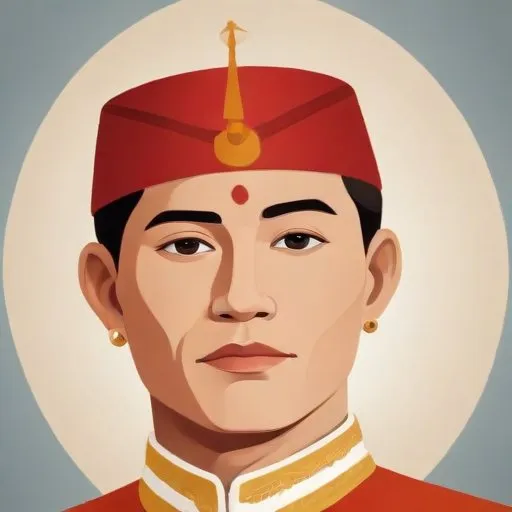
A Burmese king who expanded the Toungoo Empire, conquering several surrounding regions and establishing a strong, centralized government. He's also known for his military campaigns and administrative reforms.
Hsinbyushin, the second son of Alaungpaya, is renowned for his unwavering determination to defend Burma's independence and his unrelenting pursuit of expansionist policies during his reign from 1763 to 1776. He is remembered as the most militaristic king of the Konbaung dynasty, a era marked by wars with Qing China and Siam, and his triumphant victories that etched his name in the annals of Burmese history.
Born on September 12, 1736, Hsinbyushin was groomed for greatness, serving as the deputy commander-in-chief during his father's reunification campaigns from 1752 to 1759. This experience instilled in him the military prowess and strategic acumen that would later define his reign.
Hsinbyushin's expansionist policies led to a series of conflicts with neighboring kingdoms. His successful defense against four Qing invasions not only preserved Burmese independence but also showcased his brilliant military tactics. The 1765 invasion of Ayutthaya brought an end to the Ayutthaya Kingdom, cementing his reputation as a formidable warlord.
Despite his military prowess, Hsinbyushin's reckless decision to wage two simultaneous wars against China and Siam nearly cost Burma its independence. The third Chinese invasion forced him to hastily withdraw from Siam, leading to an uneasy truce in 1769. The subsequent period was marked by mistreatment of the population by army commanders, local governors, and warlords.
Hsinbyushin's reign was cut short by a long illness that ultimately claimed his life in June 1776. His legacy is a testament to his bravery, military genius, and unwavering dedication to his kingdom. Despite the challenges faced during his reign, Hsinbyushin remains an iconic figure in Burmese history, celebrated for his role in shaping the country's destiny.
Hsinbyushin's military campaigns and expansionist policies have had a lasting impact on modern Burmese society. His legacy continues to inspire national pride and a sense of cultural identity among the Burmese people. His military conquests also led to the exchange of ideas, cultures, and traditions between Burma and its neighboring kingdoms, enriching the region's cultural heritage.
Born in 1516
Unifier of Burma, conqueror of Siam and Lan Xang, and creator of the largest empire in Southeast Asian history. He expanded Buddhism and established a strong administrative system.
Born in 1516
Unified Burma under a single rule, expanded the empire, and promoted Theravada Buddhism. Known for military conquests and cultural achievements.
Born in 1535
The king who unified Burma and established the Toungoo Empire, known for his military conquests and administrative reforms. He is also famous for his architectural achievements, including the construction of the Kanbawzathadi Palace.
Born in 1859
The last king of the Konbaung dynasty, who ruled Burma from 1878 to 1885 and was exiled by the British, leaving a legacy of cultural and national identity. He's known for his attempts to modernize and westernize Burma while preserving its traditions.
Born in 1030
A powerful king who unified Burma and expanded its borders, known for his military conquests and patronage of Buddhism.
Born in 1714
Unified Burma's warring states, establishing the Konbaung dynasty, and expanding the empire through military conquests. He's remembered for his military prowess and unification of Burma.
