


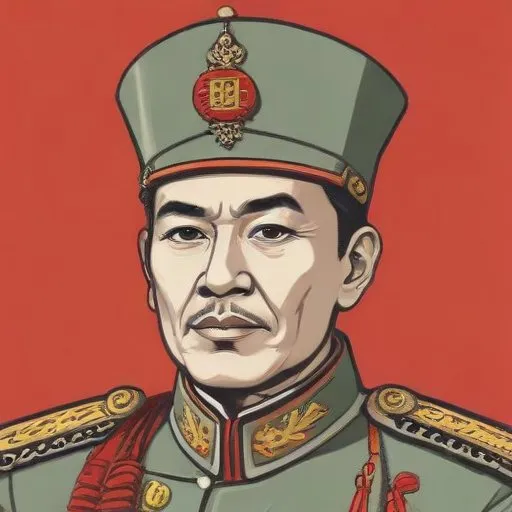
A renowned Ming dynasty general who defended China against Japanese pirates and is celebrated for his bravery and strategic military tactics.
Hu Zongxian, a renowned Chinese general and politician of the Ming dynasty, is celebrated for his valiant efforts in combating the wokou pirate raids during the reign of the Jiajing Emperor. His unwavering determination and strategic prowess ultimately led to the defeat of notorious pirate lords, earning him a revered place in Chinese history.
Born in 1512 in Longchuan, Jixi County, Huizhou prefecture (now part of Anhui province), Hu Zongxian demonstrated exceptional intellectual and martial abilities from an early age. At 23, he passed the provincial imperial examination, becoming a juren, and later secured a jinshi degree in 1538, paving the way for his official career.
His administrative prowess was first showcased in Yidu, Shandong province, where he served as magistrate from 1540. His justice and compassion earned him the affection of the people, who credited him with bringing rain during a severe drought and summoning magpies to devour locusts that threatened their crops.
Hu's remarkable achievements in Shandong caught the attention of the imperial court, earmarking him for promotion. However, he was forced to retire temporarily due to the death of his mother in 1542, adhering to the three-year mourning period dictated by Confucian rituals. Two years later, he re-entered public life, destined to play a pivotal role in shaping China's response to the wokou pirate menace.
In 1556, Hu Zongxian, as supreme commander, successfully repelled a massive pirate raid led by Xu Hai, employing clever ruses to outmaneuver the formidable pirate fleet. This victory was followed by the capture of the notorious pirate lord Wang Zhi in 1557, a feat that cemented Hu's reputation as a master strategist.
Despite his remarkable accomplishments, Hu Zongxian's association with the clique of Yan Song and Zhao Wenhua, reviled figures in Ming historiography, initially tarnished his reputation. However, decades after his death, he was rehabilitated, and in 1595, the emperor bestowed upon him the posthumous name Xiangmao. Today, Hu Zongxian is recognized as a brilliant military commander and a devoted public servant.
As we reflect on the life and achievements of Hu Zongxian, we are reminded of the enduring importance of courage, strategic thinking, and dedication to public service. This remarkable individual not only shaped the course of Chinese history but also left an indelible mark on the collective consciousness of his people.
Born in 1130
A leading figure in Confucianism, he synthesized Confucian classics into a coherent philosophical system, influencing East Asian thought for centuries. His teachings emphasized moral cultivation and self-reflection.
Born in 1472
A 16th-century Chinese philosopher who merged Confucianism with Taoist and Buddhist elements, emphasizing individual moral intuition and the unity of knowledge and action.
