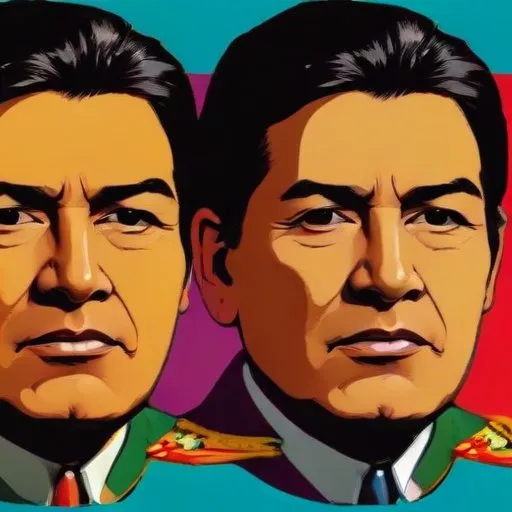
Hugo Banzer: The Controversial Bolivian Leader
A Turbulent Career in Politics
Hugo Banzer Suárez, a Bolivian politician and military officer, is known for his tumultuous reign as the 51st President of Bolivia, a position he held twice, from 1971 to 1978 and again from 1997 to 2001. During his first tenure, he ruled as a military dictator, while his second term was as a democratically elected president, marking a significant shift in his political trajectory.
Military and Ideological Formation
Born on May 10, 1926, in the rural lowlands of the Santa Cruz Department, Banzer's early life was shaped by his military education. He attended prestigious military schools in Bolivia, Argentina, Brazil, and the United States, including the Armored Cavalry School at Fort Hood, Texas. This rigorous training laid the foundation for his future rise to power.
Rise to Power
Banzer's climb to prominence began in 1961, when he was promoted to colonel. Three years later, he was appointed to head the Ministry of Education and Culture in the government of General
René Barrientos, a personal friend. This position marked the beginning of his involvement in politics, a realm he would soon dominate.
The Banzerato (1971-1978)
On August 22, 1971, Banzer seized power through a coup d'état, overthrowing socialist President Juan José Torres. During his reign, he implemented repressive policies, targeting labor leaders, clergymen, indigenous people, and students. Thousands of Bolivians were forced into exile, arrested, tortured, or killed, earning this era the ominous title of "Banzerato."
Democratic Interlude and Second Term
After being ousted in 1978, Banzer remained a influential figure in Bolivian politics. He contested several presidential elections, eventually winning in 1997 with a narrow plurality of 22.26% of the popular vote. During his second term, he extended presidential term limits from four to five years and presided over the Cochabamba Water War, declaring a state of siege in 2000 that suspended several civil liberties.
Legacy and Resignation
Banzer's resignation in 2001, following his diagnosis with lung cancer, marked the end of his presidency. He was succeeded by Vice President Jorge Quiroga. Despite his controversial legacy, Banzer's path from military dictator to democratically elected president remains a fascinating chapter in Bolivian history.
Personal Milestones and Key Life Events
- May 10, 1926: Born in the rural lowlands of the Santa Cruz Department
- 1961: Promoted to colonel
- 1964: Appointed to head the Ministry of Education and Culture
- August 22, 1971: Seized power through a coup d'état
- 1978: Ousted from power
- 1997: Elected as President of Bolivia
- 2000: Declared a state of siege during the Cochabamba Water War
- 2001: Resigned due to ill health
- May 5, 2002: Passed away
Historical Context and Legacy
Banzer's life and career serve as a microcosm of Bolivia's turbulent 20th century, marked by coups, dictatorships, and struggles for democracy. His legacy, while controversial, remains an integral part of Bolivian history, offering valuable lessons on the dangers of authoritarianism and the importance of democratic institutions.
FAQ
What was Hugo Banzers role in Bolivian politics?
Hugo Banzer was a Bolivian general and politician who served as the President of Bolivia from 1971 to 1978 and again from 1997 to 2001. He was a key figure in Bolivian politics for over three decades.
What were Hugo Banzers notable achievements as President?
Banzers presidencies were marked by economic reforms, infrastructure development, and improvements in education and healthcare. He also implemented several initiatives to combat poverty and inequality.
What international awards did Hugo Banzer receive?
Banzer received several international awards and honors for his leadership and contributions to Bolivias development, including the Grand Cross of the Order of the Sun of Peru.
What was Hugo Banzers early life like?
Banzer was born in 1926 in Conception, Bolivia. He graduated from the Bolivian Military Academy and later became a high-ranking officer in the Bolivian Army.
How did Hugo Banzers legacy impact Bolivia?
Banzers legacy in Bolivia is that of a dedicated leader who worked to modernize the country and improve the lives of its citizens. He will be remembered for his commitment to Bolivias development and his role in shaping the countrys future.