


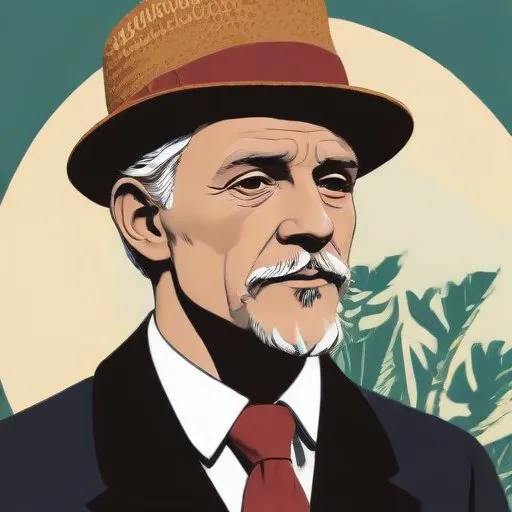
A poet, sculptor, and gardener who created innovative, nature-inspired artworks that blurred the lines between language, art, and environment. His unique fusion of words and visual elements continues to inspire artists and designers today.
Ian Hamilton Finlay, a Scottish poet, writer, artist, and gardener, is best known for his pioneering work in concrete poetry, a radical form of poetry that challenges traditional notions of language and form. His innovative use of typography, layout, and visual arrangement transformed the way words interact with the page, earning him international recognition and acclaim.
Born on October 28, 1925, in Nassau, Bahamas, to Scottish parents James Hamilton Finlay and Annie Pettigrew, Ian was educated at Dollar Academy in Clackmannanshire and later at Glasgow School of Art. With the outbreak of World War II, he was evacuated to family in the countryside, first to Gartmore and then to Kirkudbright, where he spent his teenage years.
After the war, Finlay worked as a shepherd on the island of Rousay, in Orkney, where he began writing short stories and poems. His first book, The Sea Bed and Other Stories, was published in 1958, followed by his first collection of poetry, The Dancers Inherit the Party, in 1960. The latter was initially published by Migrant Press and later re-released by Fulcrum Press London in 1969, sparking a legal dispute over the edition number.
In 1963, Finlay published Rapel, his groundbreaking collection of concrete poetry, which revolutionized the literary world. This innovative form of poetry blurred the lines between language and visual art, using typography and layout to enhance the meaning of the words. Through his own Wild Hawthorn Press, Finlay issued many of his concrete poetry works, including his magazine Poor. Old. Tired. Horse.
Finlay married twice and had two children, Alec and Ailie. Throughout his life, he struggled with agoraphobia, which significantly impacted his daily life. Despite these challenges, he remained committed to his art, leaving behind a profound legacy in the world of poetry.
Finlay's concrete poetry not only influenced future generations of poets but also inspired artists, designers, and writers across various disciplines. His work continues to be celebrated for its innovative spirit, challenging the boundaries of language and form. Today, his poetry is recognized as a pioneering force in the development of modern poetry.
Ian Hamilton Finlay passed away on March 27, 2006, leaving behind a profound legacy in the world of poetry and art. His contributions to concrete poetry continue to inspire and challenge writers, artists, and thinkers today.
Finlay's innovative work has influenced numerous artists, poets, and designers, shaping the course of modern poetry and visual art. His rebellious spirit and refusal to conform to traditional forms of poetry have inspired generations of creatives, cementing his place as a pioneer in the world of concrete poetry.
Born in 1911
A celebrated poet and educator who explored the intersection of Gaelic culture and modernist poetry, leaving a lasting impact on Scottish literature.
Born in 1892
A leading figure in the Scottish Renaissance, he's renowned for his innovative poetry and advocacy for a distinct Scottish language and culture.
Born in 1920
A Scottish poet and translator celebrated for his innovative and eclectic style, blending traditional forms with modernist experimentation, and renowned for his translations of poetry from over 40 languages.
Born in 1921
A celebrated writer of novels, short stories, and poetry that often explored the history and culture of the Orkney Islands, where he lived. His work is known for its lyricism and sense of place.
