


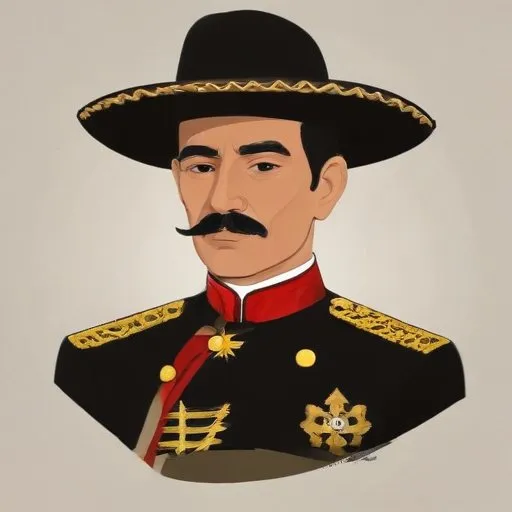
Led the Mexican army to victory against the French at the Battle of Puebla on May 5, 1862, a triumph that's celebrated as Cinco de Mayo. He's a national hero in Mexico, symbolizing resistance against foreign occupation.
Ignacio Zaragoza is renowned for leading the Mexican army to a remarkable victory against the French forces at the Battle of Puebla on May 5, 1862. This triumph, celebrated in the United States as Cinco de Mayo, was a testament to Zaragoza's military prowess and strategic thinking.
Born on March 24, 1829, in the village of Bahía del Espíritu Santo, in the state of Coahuila y Tejas (now Goliad, Texas, USA), Zaragoza was the son of Miguel G. Zaragoza and María de Jesús Seguín. His father, a military officer, procured land in Texas in 1830, providing a more lucrative living as a rancher.
The Zaragoza family moved to Matamoros in 1834 and then to Monterrey in 1844, where young Ignacio entered a seminary. However, by 1846, he grew tired of his seminary life and opted to pursue a military career, enrolling as a cadet in the Mexican army during the Mexican-American War.
Zaragoza married María Rosa de la Riva Palacio in 1851, and they had one son, Ignacio Esteban de Zaragoza y Riva Palacio (1853-1911). As a military officer, Zaragoza participated in several battles, including the Reform War (1858-1860) and the French intervention in Mexico (1862).
On May 5, 1862, Zaragoza led the Mexican army of 600 men against the invading French forces, comprising 6,500 soldiers, including the elite French legionnaires. Against all odds, the Mexican army emerged victorious, securing a crucial win for Mexico.
Zaragoza's victory at the Battle of Puebla had significant implications for Mexico's sovereignty and independence. His bravery and strategic thinking inspired the Mexican people, earning him the title "El Heroe de la Batalla de Puebla" (The Hero of the Battle of Puebla).
Today, Zaragoza's legacy extends beyond Mexico. Cinco de Mayo, originally a celebration of the Battle of Puebla, has become a popular cultural event in the United States, often misattributed as Mexico's independence day.
Zaragoza's words of encouragement to his soldiers before the Battle of Puebla have become legendary: "¡Viva la Patria!" ("Long live the Motherland!") and "¡Viva México!" ("Long live Mexico!").
Zaragoza's legacy serves as a reminder of the importance of patriotism, bravery, and strategic thinking. His contributions to Mexico's history have made him an enduring symbol of national pride.
Born in 1765
A Mexican priest who led the country's war for independence from Spain, known for his bravery and strategic military tactics. He's considered a national hero in Mexico.
Born in 1783
Mexican royalist turned insurgent who led the country to independence and became its first emperor, known for uniting the country and establishing the Mexican Empire. He played a crucial role in shaping Mexico's early history.
Born in 1806
A champion of democracy and indigenous rights, he modernized Mexico, abolished slavery, and limited church power. He's revered as a national hero for his progressive reforms.
Born in 1830
A Mexican general and politician who ruled Mexico with an iron fist from 1876 to 1911, modernizing the country while suppressing dissent and opposition. He's infamous for his authoritarian regime and eventual exile.
Born in 1859
A Mexican revolutionary leader who served as president from 1917 to 1920, known for his role in the Mexican Revolution and drafting the country's 1917 constitution.
Born in 1880
Mexican general and politician who served as the 39th President of Mexico, known for his role in the Mexican Revolution and his efforts to modernize the country. He's also famous for losing his right arm in battle and continuing to serve as president.
Born in 1895
A Mexican revolutionary general who served as president, implementing significant land reforms and nationalizing the oil industry, and father of a prominent politician.
