


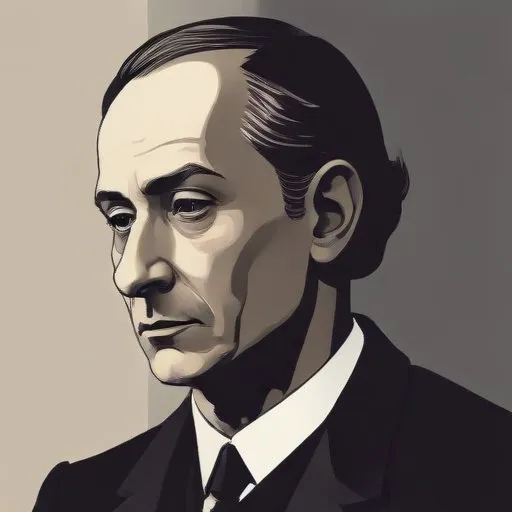
A Russian poet and critic who explored the intersection of literature and philosophy, known for his innovative and influential poetry that blended symbolism and futurism.
Innokenty Annensky, a Russian poet, critic, scholar, and translator, is renowned for his profound contribution to the world of Russian Symbolism, despite his lack of recognition during his lifetime. His work, infused with associate symbolism, drew inspiration from French Symbolism and poets like Stéphane Mallarmé, earning him a revered position among the early 20th-century Russian poetic circle.
Born on September 1, 1855, in Omsk, Russia, Annensky grew up in Saint Petersburg after his family relocated in 1860. Orphaned at a young age, he was raised by his older brother, Nikolai Annensky, a prominent Narodnik and political activist.
Annensky's scholarly pursuits began at St. Petersburg University, where he graduated from the philological department in 1879. He specialized in Historical-Comparative Linguistics, laying the foundation for his future academic and literary endeavors.
As a teacher, Annensky shared his knowledge of classical languages and ancient literature studies with students at a gymnasium in Tsarskoe Selo. His dedication to education led to his appointment as the school's director in 1886, a position he held until his death in 1909.
Annensky's literary pursuits flourished alongside his academic career. He translated classic Greek works and penned essays and reviews, although he never sought to make a living from his writing. Instead, he poured his heart into his poetry, crafting a unique style that blended symbolism with associative imagery.
Despite his relative anonymity during his lifetime, Annensky's work inspired a constellation of prominent Russian poets, including Osip Mandelstam, Anna Akhmatova, Boris Pasternak, and Vladimir Mayakovsky. These literary giants drew inspiration from Annensky's innovative approach to symbolism, catapulting him to posthumous recognition.
Annensky's poetry shares striking similarities with that of Stéphane Mallarmé, the French poet. Both masters employed associative symbolism, weaving intricate webs of imagery and meaning. This parallel has led critics to acknowledge Annensky's significance in the Russian Symbolist movement.
Innokenty Annensky's legacy extends beyond the realm of literature. His dedication to education and his innovative approach to poetry have inspired generations of scholars, poets, and artists. His unique style has enriched the cultural landscape, fostering a deeper understanding and appreciation of Russian Symbolism.
Today, Annensky's work serves as a testament to the power of artistic expression, reminding us that even the most unsung heroes can leave an indelible mark on the world.
Born in 1880
A Russian literary giant, known for pioneering the avant-garde movement in literature, blending poetry and prose to create innovative, symbolic works that explored the human experience.
Born in 1880
A leading figure of the Russian Symbolist movement, known for his lyrical and mystical poetry that explored the human condition and the search for meaning. His works are considered a bridge between 19th-century Romanticism and 20th-century Modernism.
Born in 1893
A Russian avant-garde artist who revolutionized poetry and theater with his bold, futuristic style and passionate performances. He's most famous for his vibrant, propaganda-inspired posters and poems that captured the spirit of the Russian Revolution.
Born in 1890
A Russian literary giant, renowned for his poetic and novelistic masterpieces, including the epic "Doctor Zhivago", which captured the essence of Soviet Russia. His works are a testament to the power of literature in shaping cultural identity.
Born in 1892
A Russian poet and author who poured her heart into lyrical verses, exploring themes of love, nature, and the human condition. Her works are a testament to her intense emotional depth and poetic genius.
Born in 1889
A renowned poet and literary icon of the Soviet era, celebrated for her poignant and evocative works that captured the essence of love, loss, and resilience amidst war and oppression.
Born in 1899
A Russian-born novelist and critic, renowned for crafting intricate, lyrical prose and exploring themes of identity, morality, and the human condition through works like "Lolita" and "Pale Fire".
Born in 1821
A Russian literary mastermind who penned psychologically complex novels that probed the human condition, exploring themes of morality, philosophy, and the darker aspects of human nature.
