


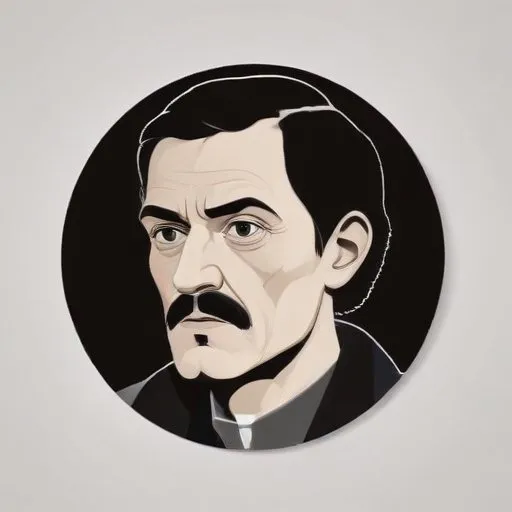
A leading figure of the Russian Symbolist movement, known for his lyrical and mystical poetry that explored the human condition and the search for meaning. His works are considered a bridge between 19th-century Romanticism and 20th-century Modernism.
Alexander Blok, a luminary of the Russian Silver Age, is renowned for his lyrical poetry, poignant plays, and prophetic writings that captured the essence of Russia's tumultuous early 20th century. As a poet, publicist, playwright, translator, and literary critic, Blok's work embodied the spirit of his era, weaving a tapestry of philosophical and spiritual explorations that continue to captivate readers today.
Blok was born on November 28, 1880, in Saint Petersburg, Russia, to an intellectual family. His father, Alexander Lvovich Blok, was a law professor, and his maternal grandfather, Andrey Beketov, was a celebrated botanist and rector of Saint Petersburg State University. After his parents' separation, Blok lived with aristocratic relatives at the Shakhmatovo manor near Moscow, where he discovered the philosophy of Vladimir Solovyov and the verse of 19th-century poets Fyodor Tyutchev and Afanasy Fet.
In 1903, Blok married Lyubov Lyuba Dmitrievna Mendeleeva, daughter of the renowned chemist Dmitri Mendeleev. This union inspired a cycle of poetry, Verses About the Beautiful Lady (1904), which catapulted him to fame. Blok's marriage was also marked by a complicated love-hate relationship with fellow Symbolist Andrei Bely.
Blok enthusiastically greeted the 1905 Russian Revolution, and his work began to reflect his prophetic vision of Russia's destiny. During the last period of his life, he emphasized political themes, pondering the messianic fate of his country in poems like Vozmezdie (1910-1912) and Rodina (1907-1916). Influenced by Solovyov's doctrines, Blok's work often vacillated between hope and despair, reflecting his apocalyptic apprehensions.
Blok's major works include The Twelve (1918), a poem that prophesied the Russian Revolution, and The Puppet Show (1906), a play that satirized the bourgeoisie. His poetry collection, Ante Lucem, showcased his early influences and laid the groundwork for his later masterpieces. Blok's legacy extends beyond his writing, as his prophetic vision and philosophical explorations continue to inspire generations of artists, writers, and thinkers.
Blok's work was deeply influenced by the philosophy of Vladimir Solovyov, which emphasized the unity of existence and the messianic role of Russia. His poetry and writings reflect his vacillation between hope and despair, as well as his apocalyptic apprehensions about the future.
Alexander Blok's legacy extends beyond literature, as his prophetic vision and philosophical explorations have inspired generations of artists, writers, and thinkers. His work continues to be a testament to the power of art to capture the essence of an era and to inspire future generations.
Born in 1893
A Russian avant-garde artist who revolutionized poetry and theater with his bold, futuristic style and passionate performances. He's most famous for his vibrant, propaganda-inspired posters and poems that captured the spirit of the Russian Revolution.
Born in 1895
A renowned Russian poet, known for his lyrical and patriotic works that often romanticized rural Russia, and his tumultuous life that ended in tragedy at a young age.
Born in 1880
A Russian literary giant, known for pioneering the avant-garde movement in literature, blending poetry and prose to create innovative, symbolic works that explored the human experience.
Born in 1890
A Russian literary giant, renowned for his poetic and novelistic masterpieces, including the epic "Doctor Zhivago", which captured the essence of Soviet Russia. His works are a testament to the power of literature in shaping cultural identity.
Born in 1889
A renowned poet and literary icon of the Soviet era, celebrated for her poignant and evocative works that captured the essence of love, loss, and resilience amidst war and oppression.
Born in 1892
A Russian poet and author who poured her heart into lyrical verses, exploring themes of love, nature, and the human condition. Her works are a testament to her intense emotional depth and poetic genius.
Born in 1906
A renowned Russian pianist and composer, known for blending classical music with dark humor and satire, creating iconic symphonies and film scores that still resonate today.
