


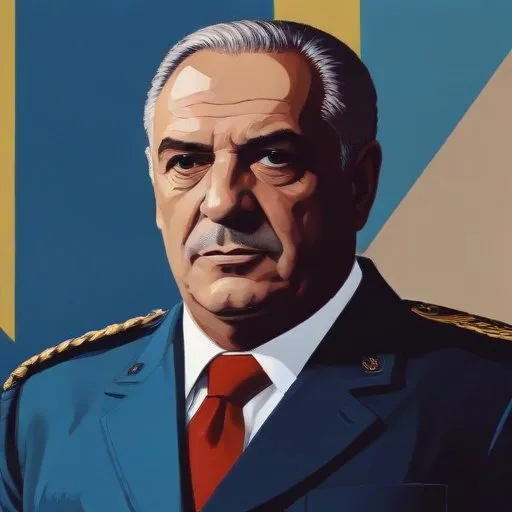
Deputy Prime Minister of Greece, serving during a tumultuous period in the country's history, known for his efforts to stabilize the government and economy.
Ioannis Charalambopoulos, a Greek Army officer and socialist politician, is known for his unwavering dedication to democracy and his unrelenting fight against authoritarian regimes. As a Minister of Foreign Affairs and Minister of National Defence, he played a pivotal role in shaping Greece's foreign policy and defense strategy during the tumultuous late 20th century.
Born on February 10, 1919, in Psari, Oichalia, Messenia, Charalambopoulos hailed from a military family and was destined for a life of service. He studied at the Hellenic Army Academy and later received a scholarship to attend Woolwich Polytechnic in the United Kingdom. During World War II, he commanded an infantry unit in the Greco-Italian War and later served in the Mediterranean and Middle East Theatre.
After leaving the army in 1963 with the rank of Colonel, Charalambopoulos transitioned into politics, joining the Center Union party. He was elected to Parliament in 1963 and 1964, representing the Messenia constituency. However, his political career was soon interrupted by the Greek military junta of 1967-1974, during which he founded the Democratic National Resistance Movement and spent three years in internal exile for his opposition to the regime.
Following the fall of the dictatorship in 1974, Charalambopoulos became a founding member of the Panhellenic Socialist Movement (PASOK). He was elected to Parliament in all elections from 1974 to 2000, representing the Athens B constituency. During this period, he played a key role in shaping PASOK's foreign policy and defense strategy.
In 1981, Charalambopoulos was appointed Minister of Foreign Affairs in the first cabinet of Andreas Papandreou, a position he held until 1985. He later served as Deputy Prime Minister from 1985 to 1988 and Minister of National Defence from 1986 to 1989. In addition, he was a provisional member of the European Parliament representing Greece from 1981 to 1984.
Throughout his long and distinguished career, Ioannis Charalambopoulos demonstrated unwavering commitment to democracy, human rights, and social justice. His fight against authoritarian regimes and his efforts to strengthen Greece's international relations have left an indelible mark on the country's political landscape. He passed away on October 16, 2014, at the age of 95, leaving behind a legacy that continues to inspire future generations.
Born in 1883
A Greek general and politician who served as Prime Minister of Greece, known for his efforts to stabilize the country during a time of political turmoil. He played a key role in shaping Greece's post-war government.
Born in 1918
Greek lawyer and politician who served as the 178th Prime Minister of Greece, known for his efforts to modernize and liberalize the Greek economy. He played a key role in Greece's accession to the European Union.
Born in 1919
Greek economist and politician who served as Prime Minister of Greece, known for his socialist policies and efforts to reduce Greece's reliance on foreign capital. He also played a key role in Greece's accession to the European Union.
Born in 1888
A Greek lawyer, economist, and politician who served as the Prime Minister of Greece from 2009 to 2011, known for his efforts to address the country's debt crisis.
Born in 1907
A Greek lawyer and politician who served as President of Greece, known for leading the country's transition from military dictatorship to democracy. He's credited with modernizing Greece and joining the European Union.
Born in 1864
A Greek statesman who played a crucial role in shaping modern Greece, leading the country through significant reforms and transformations. He's known for his visionary leadership and diplomatic prowess.
Born in 1867
A Greek lawyer and politician who served as the 94th Prime Minister of Greece, known for his brief but tumultuous tenure marked by controversy and scandal.
