


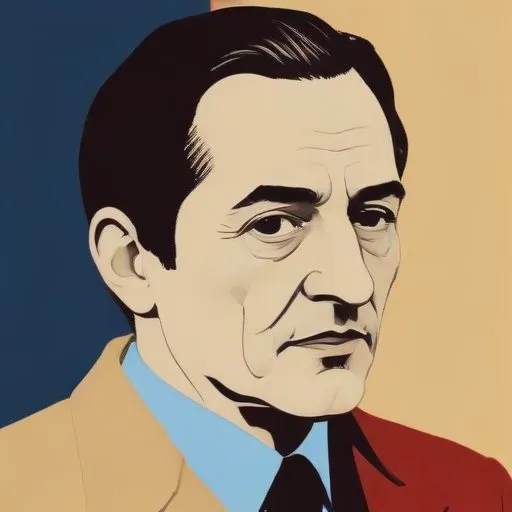
A Romanian literary figure who wrote influential poetry and criticism, shaping the country's modernist movement. Known for his innovative style and exploration of themes like love and existentialism.
Ion Minulescu, a trailblazing Romanian poet, novelist, short story writer, journalist, literary critic, and playwright, left an indelible mark on the country's literary landscape. His innovative and avant-garde approach to literature, heavily influenced by the Symbolist movement, earned him a reputation as a pioneer of modernist poetry in Romania.
Born on January 6, 1881, in Bucharest, Romania, Minulescu's early life was marked by a strong connection to his mother, Alexandrina Ciuc, a widow who later married Ion Constantinescu, a Romanian Army officer. This unconventional family setup would later influence his writing, which often explored themes of identity, morality, and the human condition.
Minulescu's literary journey began at the tender age of 16, when he published his first verses in 1897. This early start was followed by a four-year stint in Paris, where he studied law at the University of Paris (1900-1904). It was during this period that he was deeply influenced by the works of Romantic and Symbolist writers, such as Gérard de Nerval and Arthur Rimbaud. The Parisian experience had a profound impact on his writing style, which became characterized by a sense of rebellion and nonconformity.
Minulescu's return to Bucharest marked the beginning of a prolific writing career, during which he published numerous poems, short stories, and novels. His poetry, in particular, was revolutionary, as he introduced free verse to Romanian literature, breaking away from traditional forms. His literary criticism and journalism also played a significant role in shaping the country's literary landscape.
Minulescu's innovative approach to literature had a profound impact on Romanian modernist movement. He was one of the first local poets to experiment with free verse, paving the way for future generations of writers. His influence can be seen in the works of writers such as Tudor Arghezi, Ion Barbu, and Mateiu Caragiale, who were all influenced by his avant-garde style.
Minulescu's personal life was marked by a sense of restlessness and rebellion. He adopted various pseudonyms, including I. M. Nirvan and KohiNoor, which reflected his desire for creative freedom and his disdain for conventional norms. His legacy, however, is one of literary innovation and pioneering spirit, which continues to inspire Romanian writers and intellectuals.
Ion Minulescu's life and legacy serve as a testament to the power of literary innovation and the importance of challenging conventional norms. His contributions to Romanian literature continue to inspire and influence writers, ensuring his place as one of the country's most beloved and respected literary figures.
Born in 1880
A Romanian literary giant, celebrated for his innovative poetry and sharp journalistic wit, leaving an indelible mark on Eastern European literature.
Born in 1885
A Romanian literary giant, celebrated for his thought-provoking novels and plays that explored the human condition, morality, and social issues. His works are considered cornerstones of Romanian literature.
Born in 1909
A Romanian-French playwright and critic, known for his absurdist plays that ridicule the human condition, exploring the futility of communication and the search for meaning in a seemingly meaningless world.
93 Years Old
A Romanian poet celebrated for his innovative and provocative style, blending surrealism with traditional forms to explore themes of love, nature, and the human condition.
Born in 1850
A renowned Romanian writer and poet, celebrated for his romantic and patriotic works that explored the human condition, love, and national identity.
