


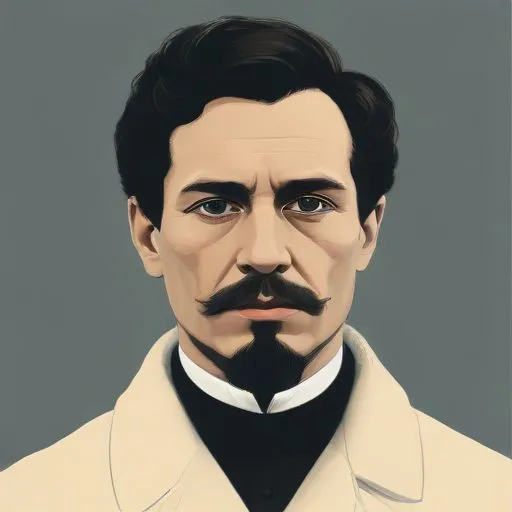
A Russian painter and illustrator renowned for capturing the serene beauty of landscapes and the fleeting effects of light, evoking a sense of melancholy and nostalgia.
Isaac Levitan, a renowned Russian landscape painter, is celebrated for advancing the genre of mood landscapes, evoking emotions and capturing the essence of the natural world. His unique style, characterized by subtle color harmonies and atmospheric lighting, has left an indelible mark on the world of art.
Levitan was born on August 18, 1860, in the shtetl of Kibarty, Augustów Governorate, Congress Poland (present-day Lithuania), to a poor but educated Jewish family. His father, Elyashiv Levitan, was the son of a rabbi and worked as a teacher and translator.
In 1870, the Levitan family moved to Moscow, where Isaac's artistic talent was nurtured. In 1873, he enrolled in the Moscow School of Painting, Sculpture, and Architecture, where he studied under prominent artists such as Alexei Savrasov, Vasily Perov, and Vasily Polenov.
In 1877, Levitan's works were first publicly exhibited, garnering critical acclaim and recognition. His talent and achievements earned him a scholarship, allowing him to continue his education despite the family's financial struggles.
Tragedy struck in 1877 when Levitan's mother passed away, followed by his father's illness and eventual death in 1879. Despite these challenges, Levitan persevered, driven by his passion for art.
Levitan's unique style, characterized by dreamy, atmospheric landscapes, set him apart from his contemporaries. His use of color and light evoked emotions and moods, creating a sense of intimacy and connection with nature.
He is credited with advancing the genre of mood landscapes, which emphasized the emotional and psychological aspects of the natural world. Levitan's innovative approach paved the way for future generations of landscape painters.
In 1875, Levitan met Nikolai Chekhov, brother of the renowned Russian writer Anton Chekhov. The two formed a close bond, with Chekhov becoming Levitan's closest friend and confidant.
Their friendship had a profound impact on both artists, with Levitan's landscapes influencing Chekhov's writing, and Chekhov's literary works inspiring Levitan's artistic vision.
Levitan's contributions to the world of art are undeniable. His innovative style and emphasis on mood landscapes have inspired generations of artists, from the Russian avant-garde to modern landscape painters.
Today, Levitan's works are celebrated worldwide, with many of his paintings held in high esteem at prominent museums and galleries, including the Tretyakov Gallery in Moscow and the Hermitage Museum in St. Petersburg.
These iconic works showcase Levitan's mastery of mood landscapes, transporting viewers to a world of serenity and contemplation.
Isaac Levitan's legacy continues to inspire and captivate art lovers, cementing his place as one of the most important Russian landscape painters of all time.
Born in 1860
A renowned Russian literary mastermind, celebrated for crafting poignant, psychologically nuanced tales that probe the human condition, and pioneering the modern short story genre.
Born in 1828
A Russian literary giant who penned sweeping novels like "War and Peace" and "Anna Karenina", exploring the human condition with profound insight and masterful storytelling.
Born in 1821
A Russian literary mastermind who penned psychologically complex novels that probed the human condition, exploring themes of morality, philosophy, and the darker aspects of human nature.
Born in 1818
A Russian literary mastermind who crafted poignant novels and plays that explored the human condition, delving into themes of love, family, and social change.
Born in 1844
A Russian master of realism, known for vivid depictions of Russian life and history, capturing the essence of the human experience through his brushstrokes.
Born in 1861
A Russian-French painter and set designer who blended Impressionism and Art Nouveau styles, creating vibrant, expressive works for the Ballets Russes and opera productions.
Born in 1856
A Russian Symbolist painter who created vibrant, dreamlike works that blended fantasy and reality, often featuring mythical creatures and folklore-inspired themes.
