


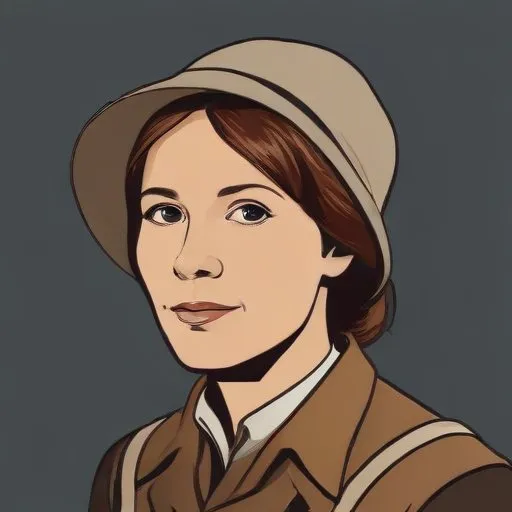
A daring and unconventional adventurer who traveled extensively throughout North Africa, documenting her experiences and writing vivid accounts of the people and landscapes she encountered.
Isabelle Eberhardt, a Swiss explorer and author, is known for her daring adventures in North Africa, her works of literature, and her unconventional lifestyle. At just 27 years old, she left an indelible mark on the world, earning her reputation as a trailblazing pioneer in a predominantly male-dominated field.
Isabelle Eberhardt was born on February 17, 1877, in Geneva, Switzerland, to Alexandre Trophimowsky and Nathalie Moerder neé Eberhardt. Her father, an Armenian anarchist, tutor, and former Orthodox priest turned atheist, and her mother, the illegitimate daughter of a middle-class Lutheran German and a Russian Jew, instilled in her a love for learning and a strong sense of independence.
As a teenager, Eberhardt began publishing short stories under a male pseudonym, showcasing her literary talents. Her fascination with North Africa grew, and despite learning about the region only through correspondence, she became a proficient writer on the subject. In 1897, she received an invitation from photographer Louis David to visit Algeria, which marked the beginning of her extraordinary journey.
In Algeria, Eberhardt dressed as a man and converted to Islam, taking on the name Si Mahmoud Saadi. This bold move allowed her to interact more freely with the local population and gain a deeper understanding of the culture. Her decision, however, made her an outcast among European settlers and the French administration, who saw her as an agitator or spy.
Despite attempts on her life, including a failed assassination attempt, Eberhardt continued to write and explore. In 1901, the French administration ordered her to leave Algeria, but she was allowed to return the following year after marrying her partner, the Algerian soldier Slimane Ehnni. Back in Algeria, she wrote for a newspaper published by Victor Barrucand and worked for General Hubert Lyautey.
In 1904, Eberhardt's life was cut short when she was killed by a flash flood in An Sfra at the age of 27. Her untimely death was a tragic loss, but her work and legacy lived on.
In 1906, Barrucand began publishing Eberhardt's remaining manuscripts, which received critical acclaim. Her life and work have inspired numerous adaptations, including the 1991 film "Isabelle Eberhardt" and the 2012 opera "Song from the Uproar: The Lives and Deaths of Isabelle Eberhardt." Streets were named after her in Bchar and Algiers, solidifying her status as an advocate for decolonization and a pioneering figure in the world of exploration and literature.
Born in 1854
A witty and flamboyant literary mastermind, renowned for crafting clever, humorous, and poignant works that continue to delight audiences with their clever wordplay and societal commentary.
Born in 1844
A leading figure of the French Symbolist movement, known for his sensual and emotive poetry that explored themes of love, beauty, and the human condition.
Born in 1854
A rebellious and visionary poet who abandoned literature at 21 to become an African explorer and trader, known for his vivid and expressive poetry that influenced modern literature.
Born in 1869
A French literary giant, renowned for his novels and essays that explored the human condition, morality, and the search for authenticity. His works often blurred the lines between fiction and autobiography.
Born in 1850
A French naval officer who wrote novels and travelogues that romanticized exotic cultures, influencing later authors like Joseph Conrad and Ernest Hemingway.
Born in 1808
A French Romantic poet and translator, known for his vivid and dreamlike writings that explored the realms of fantasy and the human psyche. His works often blurred the lines between reality and imagination.
Born in 1811
A French Romantic poet and critic who championed the beauty of art for art's sake, and is known for his vivid descriptions of nature and the human experience.
Born in 1821
A 19th-century literary mastermind who crafted exquisite poetry and art criticism, exploring the beauty and darkness of human experience.
