


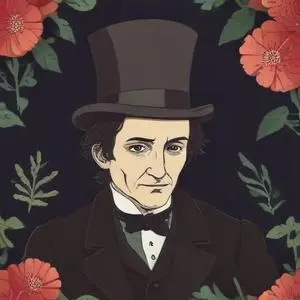
A 19th-century literary mastermind who crafted exquisite poetry and art criticism, exploring the beauty and darkness of human experience.
Charles Baudelaire, a French poet, essayist, art critic, and translator, is renowned for his masterpiece, Les Fleurs du mal (The Flowers of Evil), a collection of lyric poetry that captures the essence of modernity and the fleeting experience of life in an urban metropolis. His work's original style, which blended prose and poetry, influenced a generation of poets, including Paul Verlaine, Arthur Rimbaud, and Stéphane Mallarmé.
Born on April 9, 1821, in Paris, France, Baudelaire was the son of Joseph-François Baudelaire, a senior civil servant and amateur artist, and Caroline née Dufays. His father's premature death in 1827 left a lasting impact on Baudelaire, who would often beg his mother for money throughout his life. This early trauma would later manifest in his excessive behavior and artistic expression.
Baudelaire's poetry is characterized by its mastery of rhyme and rhythm, exoticism inherited from the Romantics, and observations of real life. His work reflected the rapidly changing nature of beauty in industrializing Paris, particularly during Haussmann's renovation of the city in the mid-19th century. Baudelaire coined the term "modernity" (modernité) to describe the ephemeral experience of life in an urban metropolis and the responsibility of artistic expression to capture that experience.
Baudelaire's innovative style and poetic philosophy had a profound impact on modern poetry. He is credited as the first Modernist by Marshall Berman, and his work influenced a range of literary movements, from Symbolism to Surrealism. His emphasis on the fleeting nature of beauty and experience paved the way for subsequent artistic movements, including Impressionism and Cubism.
Baudelaire's life was marred by controversy, including his involvement in the Revue de Paris and his prosecution for offending public morals with his poem "Les Fleurs du mal". He was fined and several of his poems were banned, adding to his reputation as a provocative and daring artist.
Baudelaire's legacy extends beyond his poetry and art criticism. He played a pivotal role in shaping the modern concept of art and beauty, influencing generations of artists, writers, and thinkers. His emphasis on the fleeting nature of experience and beauty continues to resonate with contemporary audiences.
"Inspiration comes of working every day."
"Be drunk, but be drunk with what you create, not with what you drink."
Charles Baudelaire's life and work continue to captivate and inspire us today. As a pioneer of modernity, his artistic expression and philosophical ideas continue to resonate with audiences, offering a profound reflection on the human experience and the fleeting beauty of life.
Born in 1821
A pioneering realist novelist who crafted meticulous, psychologically nuanced portrayals of 19th-century French life, particularly in his iconic novel "Madame Bovary".
Born in 1840
A pioneering figure in naturalist literature, known for his influential novels that exposed social ills and championed reform, such as "Germinal" and "Nana".
Born in 1850
A 19th-century French literary mastermind who crafted hauntingly beautiful short stories and novels that probed the human psyche, often with a dark, ironic twist. His works remain widely read and adapted today.
Born in 1811
A French Romantic poet and critic who championed the beauty of art for art's sake, and is known for his vivid descriptions of nature and the human experience.
Born in 1810
French Romantic writer who penned passionate and introspective works, including plays, poems, and novels that explored the human experience.
Born in 1799
A prolific writer who created a vast array of characters and stories that explored the human condition, particularly in the context of post-Napoleonic France. His works are considered a cornerstone of French literature.
Born in 1798
A Romantic-era master of expressive brushstrokes and vivid color, creating iconic works that captured the drama and emotion of historical and literary scenes.
