


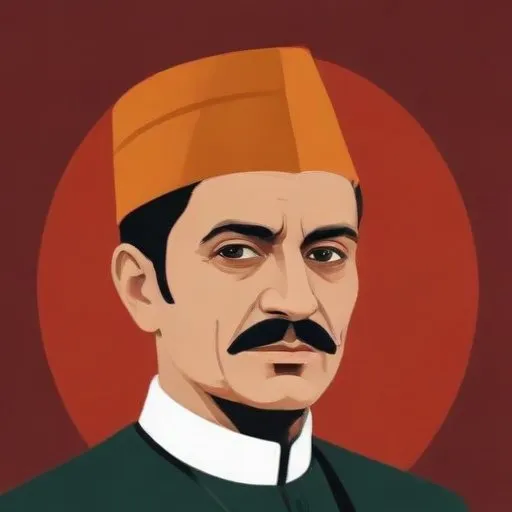
A Pakistani scholar who made significant contributions to the field of history and education, particularly in the context of Pakistan's independence movement and Islamic studies.
Ishtiaq Hussain Qureshi, popularly known as I.H. Qureshi, was a Pakistani nationalist historian and playwright who played a pivotal role in shaping the country's academic and cultural landscape. As a renowned educationalist, administrator, and scholar, Qureshi is remembered for his tireless efforts in promoting Urdu as the national language of Pakistan and his contributions to the development of the country's educational system.
Born on November 20, 1903, in a noble family of Patiyali, Kasganj District, Uttar Pradesh, British India, Qureshi was an exceptional student who excelled in his studies. He completed his matriculation in 1916 and went on to pursue his undergraduate and postgraduate degrees in history from St. Stephens College, Delhi, with distinction. His passion for learning took him to Cambridge University, where he earned a PhD degree in 1940, with a thesis on the Administration of Sultanate of Delhi.
Qureshi's association with the Pakistan Movement began in the 1940s, when he actively participated in the struggle for independence alongside Choudhary Rahmat Ali. His commitment to the cause led him to join the faculty of history at Delhi University, where he later became the dean of the Faculty of Arts and acting vice chancellor. After Pakistan gained independence in 1947, Qureshi migrated to Karachi and served as the vice chancellor of the University of Karachi from 1961 to 1971.
Qureshi's impressive academic credentials and administrative experience earned him recognition as a distinguished educator. He played a crucial role in establishing the National Language Authority (NLA) in the 1970s, which aimed to promote Urdu as the national language of Pakistan. He also founded the History Department at the University of the Punjab and later joined the faculty of history at the University of Karachi, where he spent the remainder of his life.
Qureshi's most notable contribution to Pakistani history is the editing of a four-volume series on the history of Pakistan. This monumental work is a testament to his dedication to preserving the country's rich cultural heritage. His contributions to the development of Urdu as a national language have had a lasting impact on Pakistani literature and culture. Through his writings and teachings, Qureshi inspired generations of students and scholars to explore the history and cultural significance of Pakistan.
Qureshi's services to education and literature were recognized through various awards and honors. He was awarded the Sitara-e-Pakistan (Star of Pakistan) and the Hilal-e-Imtiaz (Crescent of Excellence) for his outstanding contributions to education and literature.
Ishtiaq Hussain Qureshi's life and work serve as a beacon of inspiration for future generations of scholars, educators, and writers. His unwavering commitment to promoting Urdu as a national language and his tireless efforts to preserve Pakistan's cultural heritage have left an indelible mark on the country's academic and cultural landscape.
Born in 1893
Pakistan's first Minister of Foreign Affairs, instrumental in shaping the country's early international relations and a key figure in the United Nations. He played a crucial role in resolving the Kashmir dispute and promoting Pakistan's interests globally.
Born in 1926
A Pakistani-British physicist and academic who made groundbreaking contributions to the electroweak unification theory, earning him a Nobel Prize in Physics in 1979. His work has had a lasting impact on our understanding of the universe.
Born in 1911
A renowned poet and journalist who wrote about love, politics, and social issues, inspiring generations with his powerful and evocative words.
Born in 1895
First Prime Minister of Pakistan, leading the country to independence from British colonial rule and shaping its early years. Known for his role in the country's formative period.
Born in 1876
Leader of the All-India Muslim League, instrumental in the creation of Pakistan, and its first head of state. He's revered as the "Father of the Nation" in Pakistan.
98 Years Old
A charismatic leader who served as Pakistan's president and prime minister, known for his socialist and nationalist policies, and his role in developing Pakistan's nuclear program.
