


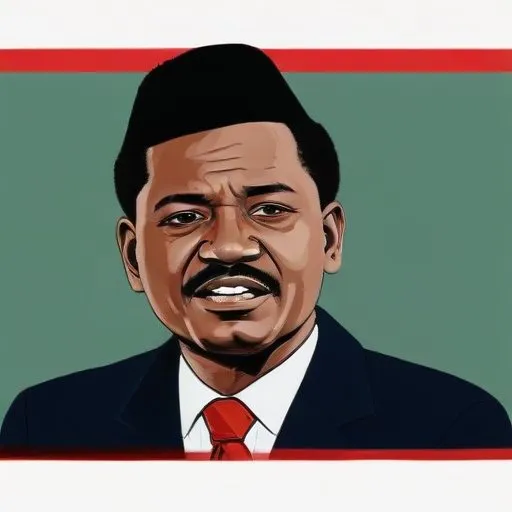
The 3rd President of Sudan, a key figure in the country's struggle for independence, known for leading the National Unionist Party and playing a crucial role in Sudan's transition from British colonial rule.
Ismail al-Azhari, a prominent Sudanese nationalist and political figure, is revered for his instrumental role in shaping the country's path to independence. As the first Prime Minister of Sudan (1954-1956) and later as the Head of State (1965-1969), al-Azhari's unwavering dedication to Sudan's sovereignty earned him a permanent place in the nation's history.
Born on October 20, 1900, in Omdurman, Sudan, al-Azhari was the son of a religious notable. He received his early education in Wad Madani and later joined the prestigious Gordon College in 1917. Although he didn't complete his education at Gordon College, al-Azhari's thirst for knowledge led him to the American University of Beirut, where he returned in 1930.
Al-Azhari's foray into politics began when he, along with other educated Sudanese, demanded greater participation in the administration of their country. To promote their objectives, they formed the Graduates General Congress in 1938, with al-Azhari serving as its Secretary-General. This marked the beginning of his illustrious career in politics, which would span over three decades.
As Prime Minister, al-Azhari played a pivotal role in Sudan's transition to independence. He submitted a proposal to declare independence to the parliament, which was met with resounding support from the people. This marked a significant milestone in Sudan's history, as the country finally shed its colonial shackles.
In 1964, al-Azhari assumed the post of President of the Council of Sovereignty, following the October Revolution. His leadership during this period was characterized by his commitment to democratic principles and his unwavering dedication to Sudan's development.
Al-Azhari's political ideology was deeply rooted in nationalism and a strong sense of Sudanese identity. He believed in the importance of self-determination and the need for Sudan to forge its own path, free from colonial influence.
Al-Azhari's contributions to Sudan's struggle for independence have had a lasting impact on the country's modern society. His legacy continues to inspire generations of Sudanese, serving as a beacon of hope and a reminder of the power of collective action.
"Independence is not a gift, it is a right that must be fought for."
Al-Azhari's leadership during a tumultuous period in Sudan's history has cemented his place as one of the country's most revered figures. His unwavering commitment to independence and democracy has inspired a nation, leaving behind a legacy that continues to shape the country's future.
Al-Azhari's camaraderie with other Sudanese intellectuals and nationalists played a significant role in shaping his political ideology. His relationships with like-minded individuals helped to forge a collective vision for Sudan's future, one that was rooted in independence and self-determination.
Al-Azhari's story has inspired numerous works of art, literature, and music, serving as a testament to the enduring power of his legacy. His life and times continue to captivate the imagination of Sudanese artists, writers, and musicians.
Throughout his life, al-Azhari was committed to improving the lives of the Sudanese people. He worked tirelessly to promote education, healthcare, and economic development, leaving behind a lasting impact on the social fabric of Sudan.
Al-Azhari's life is a testament to the power of perseverance and determination. His unwavering commitment to Sudan's independence serves as a beacon of hope, inspiring generations to strive for a better future.
90 Years Old
Former Prime Minister of Sudan who led the country's government from 1966 to 1967 and again from 1986 to 1989, known for his efforts to reform the economy and promote national unity.
Born in 1888
This Canadian-American engineer designed the iconic M1 Garand rifle, a legendary firearm that played a significant role in World War II and became an symbol of American ingenuity. He's revered for revolutionizing infantry combat with his innovative rifle design.
