


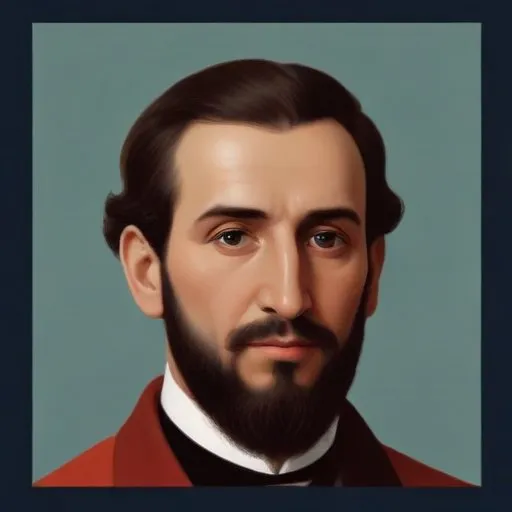
A renowned marine artist, capturing the majesty of the sea through breathtakingly realistic paintings, earning him the title "the greatest marine painter of all time".
Ivan Aivazovsky is revered as one of the greatest marine painters of all time, celebrated for his breathtaking seascapes that capture the fury and beauty of the ocean. With a career spanning nearly six decades, Aivazovsky created over 6,000 paintings, earning him the title of one of the most prolific artists of his era.
Born on July 29, 1817, in Feodosia, Crimea, Russian Empire, Aivazovsky was baptized as Hovhannes Aivazian into an Armenian family. He began his artistic training at the Imperial Academy of Arts in Saint Petersburg, where he honed his skills under the guidance of renowned Russian landscape painter, Maxim Vorobiev.
Aivazovsky's talent and dedication quickly earned him recognition, and in 1837, he was appointed as the main painter of the Russian Navy. This prestigious position allowed him to travel extensively, witnessing naval battles and maneuvers that would later inspire some of his most iconic works.
Aivazovsky's artistic oeuvre is characterized by his mastery of seascapes, which dominate his body of work. His paintings often feature dramatic, turbulent seas, set against the backdrop of rugged coastlines and majestic ships. In addition to his marine art, Aivazovsky also explored themes of battle scenes, Armenian culture, and portraiture.
Aivazovsky's work transcended national borders, earning him widespread recognition and admiration. He held numerous solo exhibitions in Europe and the United States, and his paintings can be found in prominent museums and private collections in Russia, Ukraine, Armenia, and Turkey.
Aivazovsky's close ties with the Russian military and aristocracy granted him access to the elite circles of St. Petersburg. Despite his proximity to power, Aivazovsky remained devoted to his craft and used his success to support educational and cultural institutions in his native Feodosia.
"In the struggle between the stone and the sea, the sea always wins." - Ivan Aivazovsky
Aivazovsky's words reflect his fascination with the ocean's power and his artistic philosophy, which emphasized the importance of capturing the raw energy and beauty of nature.
Aivazovsky's influence on modern art and culture is immeasurable. His seascapes have inspired generations of artists, from the Russian Romantics to contemporary painters. His legacy extends beyond the art world, as his paintings continue to evoke a sense of awe and appreciation for the ocean's majesty.
Aivazovsky's numerous accolades and honors are a testament to his artistic genius and his contributions to Russian and world culture.
Aivazovsky's remarkable life and career continue to captivate art lovers and inspire new generations of artists. His masterpieces remain an enduring testament to the power of art to evoke emotion, spark imagination, and celebrate the wonders of the natural world.
Born in 1776
A Romantic-era painter celebrated for capturing the essence of the English countryside through serene, naturalistic landscapes, often featuring skies and clouds.
Born in 1840
A founder of Impressionism, capturing fleeting light and color in dreamy landscapes and water scenes, revolutionizing modern art.
Born in 1841
A pioneer of Impressionism, creating vibrant, intimate portraits and landscapes that capture the beauty of everyday life. His works evoke a sense of joy and warmth, celebrating the human experience.
Born in 1830
A Danish-French Impressionist painter who captured the beauty of landscapes and cityscapes with vivid colors and bold brushstrokes, influencing the development of modern art.
Born in 1844
A Russian master of realism, known for vivid depictions of Russian life and history, capturing the essence of the human experience through his brushstrokes.
Born in 1848
A Russian master of historical scenes, capturing the grandeur and drama of 16th- to 18th-century Russia with vivid colors and meticulous details.
Born in 1830
A Russian painter and academic who created landscapes that evoked a sense of melancholy and nostalgia, capturing the beauty of the Russian countryside. He's particularly famous for his painting "The Rooks Have Returned" which is considered an iconic representation of Russian art.
