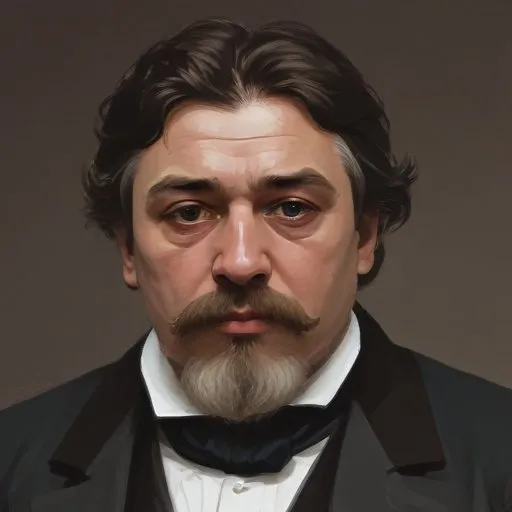
Vasily Surikov: The Renowned Russian Realist History Painter
A Master of Composition and Historical Narratives
Vasily Surikov is celebrated as one of the most prominent Russian Realist history painters of the 19th century, renowned for his meticulous attention to detail and captivating compositions that bring historical events to life. His works have become an integral part of Russian cultural heritage, evoking a sense of national pride and identity.
Early Life and Education
Born on January 24, 1848, in Krasnoyarsk, Siberia, Surikov descended from an old Yenisey Cossack family. His father, Ivan Aleksandrovich Surikov, was a Collegiate Registrar, and his family moved to the village of Sukhobuzimskoye in 1854, where Surikov began his primary education. After his father's death in 1859, the family returned to Krasnoyarsk, where Surikov's interest in art began to flourish.
Rise to Prominence
In 1862, Surikov created his first formal work, but due to financial constraints, he was unable to pursue further education. Instead, he became a clerk in a government office, where he met Pavel Zamyatin, the governor of Yenisei, who introduced him to Pyotr Kuznetsov, a local merchant who sponsored his artistic endeavors. In 1868, Surikov traveled to Saint Petersburg, where he audited classes at the Imperial Academy of Arts and later became a full-time pupil, studying under prominent artists such as
Pavel Chistyakov, Bogdan Willewalde, and Pyotr Shamshin.
Career Highlights and Major Works
Surikov's breakthrough came in 1875, when he graduated with the title of Artist, first degree. He went on to create some of his most iconic works, including:
- "The Conquest of Siberia by Yermak" (1895)
- "Menshikov in Berezovo" (1883)
- "The Boyarinya Morozova" (1887)
- "Stepan Razin" (1907)
These paintings not only showcased Surikov's technical mastery but also his ability to capture the essence of Russian history and culture.
Influence on Modern Society
Surikov's works have had a profound impact on Russian society, inspiring a sense of national identity and pride. His paintings have been widely reproduced and disseminated, making them an integral part of Russian cultural heritage.
Legacy and Historical Context
Surikov's legacy extends beyond his artistic contributions. He was a key figure in the development of Russian Realism, a movement that sought to depict everyday life and historical events with accuracy and detail. His works continue to be celebrated for their historical significance, artistic merit, and emotional resonance.
Awards and Honors
Throughout his career, Surikov received numerous awards and honors, including the title of Academician of the Imperial Academy of Arts in 1878.
Personal Life and Milestones
Surikov married Elisaveta Shreiber in 1878, and the couple had three children. Despite struggling with financial difficulties and personal losses, Surikov remained dedicated to his craft, continuing to create works that would become beloved by generations to come.
Trivia and Fun Facts
- Surikov was nicknamed "The Composer" due to his exceptional attention to composition.
- He was unable to afford a house in Moscow and lived in rented apartments throughout his life.
- Surikov's paintings have been used as illustrations in numerous publications, making his work accessible to a wider audience.
Vasily Surikov's remarkable life and artistic contributions have left an indelible mark on Russian culture and history. His dedication to his craft, attention to detail, and ability to evoke emotion through his paintings have cemented his place as one of Russia's most celebrated artists.
FAQ
What style of painting was Vasily Surikov known for?
Vasily Surikov was a Russian painter known for his mastery of historical and landscape painting. He was a prominent figure in the Russian Realist movement, capturing the lives and struggles of the Russian people.
What is Vasily Surikovs most famous work?
Vasily Surikovs most famous work is the painting The Morning of the Execution of the Streltsy, which depicts a pivotal moment in Russian history. This painting showcases his skill in capturing dramatic scenes and intense emotions.
How did Vasily Surikovs art reflect Russian culture?
Vasily Surikovs art was deeply rooted in Russian culture and history. He drew inspiration from folk tales, legends, and historical events, creating works that celebrated Russian heritage and identity.
What was Vasily Surikovs role in the Peredvizhniki movement?
Vasily Surikov was a key figure in the Peredvizhniki movement, a group of Russian artists who sought to bring art to the people. He believed in the importance of making art accessible to all, regardless of social class or background.
What is Vasily Surikovs legacy in Russian art?
Vasily Surikovs legacy in Russian art is immense. He is remembered as one of the greatest Russian painters of all time, and his works continue to inspire generations of artists and art lovers alike.