


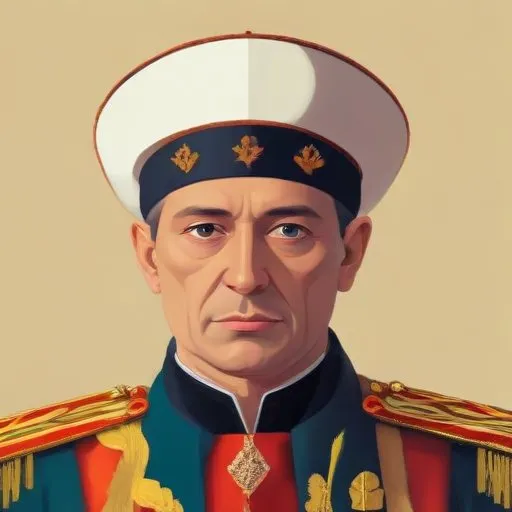
A skilled diplomat and military leader who played a crucial role in Ukraine's struggle for independence from Russia, known for his bravery and strategic alliances.
Ivan Mazepa, a Ukrainian military, political, and civic leader, is known for his tumultuous reign as the Hetman of the Zaporizhian Host and the Left-bank Ukraine from 1687 to 1708. He is infamous for his bold decision to defect from the Russian army and side with King Charles XII of Sweden in the Battle of Poltava, a move that would change the course of Ukrainian and Russian history.
Mazepa was a passionate patron of the arts, supporting various literary, artistic, and musical works. His love for culture and education led to the establishment of several schools and colleges, promoting the Ukrainian language and culture.
The Battle of Poltava in 1709 marked a turning point in Mazepa's life and career. After learning that Tsar Peter I intended to relieve him of his position and replace him with Alexander Menshikov, Mazepa defected from the Russian army and joined forces with King Charles XII of Sweden. This move was seen as a betrayal by the Russian Orthodox Church, which subsequently laid an anathema on Mazepa's name in 1708.
The Russian Orthodox Church's anathema on Mazepa's name has not been revoked to this day, and its validity is still disputed by the Ecumenical Patriarchate of Constantinople. The controversy surrounding Mazepa's defection has resonated in both Russian and Ukrainian national histories, with Mazepa being viewed as either a hero or a traitor. In Ukraine, Mazepa's image has been gradually rehabilitated since the country's independence in 1991.
Ivan Mazepa was born on March 30, 1639, in Mazepyntsi, near Bila Tserkva, in the Polish-Lithuanian Commonwealth (now Ukraine). He came from a noble Ruthenian family and was raised in a culturally rich environment that fostered his love for the arts and education.
The Ukrainian Navy has honored Mazepa's legacy by naming a corvette after him, the Hetman Ivan Mazepa. This recognition is a testament to Mazepa's enduring impact on Ukrainian history and culture.
Mazepa's actions and decisions were guided by his strong sense of patriotism and loyalty to his people. He believed in the importance of Ukrainian independence and autonomy, which drove his controversial decision to defect from the Russian army.
Mazepa's legacy has inspired numerous literary, artistic, and musical works, cementing his place in Ukrainian cultural heritage. His story has also sparked debates about loyalty, patriotism, and the ethics of war, making him a fascinating figure in modern Ukrainian society.
Through his complex and multifaceted life, Ivan Mazepa has left an indelible mark on Ukrainian and Russian history. Love him or hate him, Mazepa's courage, conviction, and passion for his country have made him an unforgettable hero of contrast.
Born in 1840
A renowned Russian composer and educator, he is best known for his iconic and beloved ballets, such as Swan Lake and The Nutcracker, which continue to enchant audiences worldwide.
74 Years Old
A Russian politician who has dominated the country's politics for over two decades, known for his authoritarian leadership style and controversial foreign policy decisions.
Born in 1879
Founded the Red Army and played a crucial role in the Russian Revolution, shaping the course of modern communism. A key figure in 20th-century politics and ideology.
Born in 1878
The Soviet Union's ruthless leader who ruled with an iron fist, implementing policies that led to widespread famine and purges, while also playing a crucial role in defeating Nazi Germany in World War II.
95 Years Old
The last leader of the Soviet Union, who introduced reforms that led to the end of the Cold War and the collapse of communism, earning a Nobel Peace Prize. He's known for his policies of glasnost and perestroika, which transformed the Soviet Union and the world.
Born in 1894
The Soviet leader who initiated reforms and denounced Stalin's regime, known for his bold policies and iconic shoe-banging incident at the UN.
Born in 1870
Founder of the world's first socialist state, leading the Bolshevik Revolution and establishing the Soviet Union, known for his radical Marxist ideology and authoritarian rule.
