


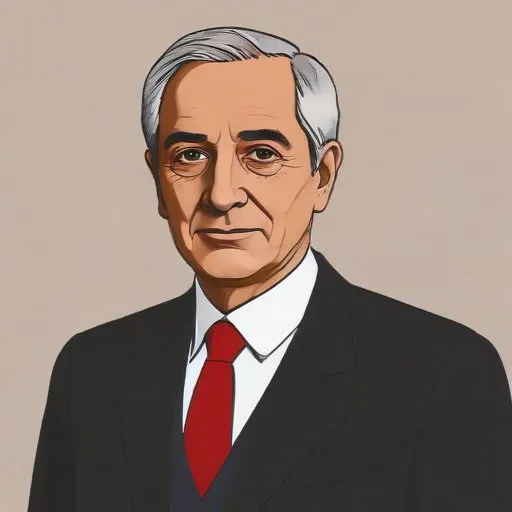
A lawyer-turned-politician who served as Italy's Prime Minister during a tumultuous post-WW1 period, known for his efforts to stabilize the country and rebuild its economy.
Ivanoe Bonomi, a influential figure in Italian politics, is best known for serving as the Prime Minister of Italy not once, but twice – from 1921 to 1922, and again from 1944 to 1945. Throughout his illustrious career, Bonomi left an indelible mark on Italy's political landscape, earning him a revered place in the country's history.
Born on October 18, 1873, in Mantua, Italy, Bonomi hailed from a bourgeois family. He pursued his passion for natural sciences at the University of Bologna, graduating in 1896. This was followed by a stint as a high school teacher, before he went on to earn a law degree from the same university.
In 1893, Bonomi was drawn to the cooperative movement and Marxist propaganda, which led him to join the Italian Socialist Party (then known as the Italian Socialist Workers Party). This marked the beginning of his involvement in politics, with notable influences from socialist leaders like Filippo Turati, Leonida Bissolati, and Anna Kuliscioff.
In August 1894, Bonomi attended the Socialist congress for the Lombardy region, a clandestine gathering due to the repressive measures imposed by Prime Minister Francesco Crispi. His activism did not go unnoticed, and in November, he was sentenced to 75 days of internal exile for his political activities.
Bonomi's political stance was characterized by reformist views, advocating for an alliance between the proletariat and the petite bourgeoisie in defense of democratic institutions. He proposed that the Party should endorse liberal, bourgeois candidates in runoff elections, with the ultimate goal of transforming Italy into a modern bourgeois democracy before establishing socialism.
Initially, Bonomi supported the idea of full land collectivization, but eventually, he shifted towards more moderate solutions, such as the voluntary creation of cooperatives in agriculture. He also criticized the decision to call the general strike of September 1904, although he collaborated with revolutionary syndicalists during the strike.
Bonomi's legacy extends beyond his two terms as Prime Minister of Italy. He played a significant role in shaping the country's political landscape, working towards democratization, and promoting social and economic reforms.
His influence can be seen in his support for reformists like Eduard Bernstein and Alexandre Millerand, as well as his efforts to transform Italy into a modern bourgeois democracy. As a statesman and journalist, Ivanoe Bonomi left an indelible mark on Italy's history, cementing his place as one of the country's most notable politicians.
Ivanoe Bonomi's life was a testament to his unwavering commitment to democracy, social justice, and the betterment of Italy. As we look back at his remarkable journey, we are reminded of the profound impact he had on the country's politics, and the lasting legacy he left behind.
Born in 1883
Italian fascist revolutionary and politician who led the National Fascist Party and ruled Italy from 1922 to 1943, known for his authoritarian regime and aggressive military campaigns.
Born in 1842
The 13th Prime Minister of Italy, a master of political maneuvering, dominated Italian politics in the early 20th century with his flexible and pragmatic approach. He's most known for his ability to maintain power and stability during a time of great social and economic change.
Born in 1874
An Italian economist and politician who served as the 2nd President of the Italian Republic, known for his economic reforms and role in shaping post-WWII Italy. He's a key figure in Italian history and politics.
Born in 1881
Italian journalist and politician who served as the 30th Prime Minister of Italy, leading the country's post-WWII reconstruction and European integration efforts. He's known for his key role in shaping modern Italy's politics and economy.
Born in 1916
The 39th Prime Minister of Italy, a prominent figure in post-war Italian politics, known for his efforts to establish a historic compromise between Christian Democrats and Communists. He was kidnapped and murdered by the Red Brigades in 1978.
Born in 1908
Italian journalist and politician who served as Prime Minister of Italy six times, playing a key role in shaping the country's post-war politics and economy. He was a dominant figure in Italian politics for over three decades.
Born in 1925
A prominent Italian journalist and politician who served as Prime Minister of Italy, known for his leadership during a tumultuous period in the country's history. He played a key role in shaping Italy's post-war politics and economy.
