


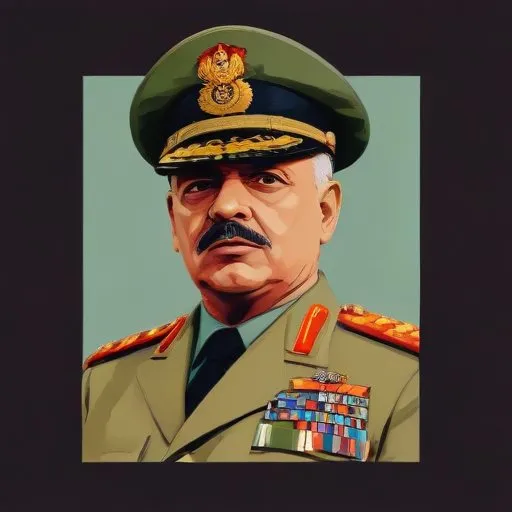
A former Iraqi vice president and kingpin of the insurgency against US forces, known for leading the Naqshbandi Army and being a key figure in the Sunni insurgency following the US invasion of Iraq.
Izzat Ibrahim alDouri, known as the "Iceman" due to his humble origins selling blocks of ice, was a prominent Iraqi politician and army field marshal who served as Vice Chairman of the Iraqi Revolutionary Command Council until the 2003 U.S. invasion of Iraq. He was regarded as the closest advisor and deputy under President Saddam Hussein, making him a household name in the Middle East and a key figure in Iraqi politics.
AlDouri was born in 1942 in Ad-Dawr, near the Iraqi town of Tikrit, to Ibrahim Khalil alDouri, a farmer, and Hamdah Saloum alDouri. His family belonged to the Al-Shuwaikhat clan of the Jabour tribe. Not much is known about his early life, but it is clear that he rose through the ranks of Iraqi politics quickly, becoming a trusted advisor to Saddam Hussein.
AlDouri's rise to power was rapid, and he became one of the most influential figures in Iraq during Saddam Hussein's regime. He served as Vice Chairman of the Iraqi Revolutionary Command Council, making him the second-in-command in the country. He was also a high-ranking member of the Iraqi Baath Party, which was the ruling party of Iraq at the time.
After the 2003 U.S. invasion of Iraq, alDouri became one of the leaders of the Iraqi insurgency against the occupying forces. He led the Naqshbandi Army, a prominent insurgent group, and was considered one of the most wanted men in Iraq. His leadership skills and military strategy made him a formidable opponent, and he was able to evade capture for many years.
AlDouri's legacy is marred by controversy, with many regarding him as a war criminal and a key figure in the brutal regime of Saddam Hussein. However, to others, he was a national hero who fought against foreign occupation and defended Iraqi sovereignty. His insurgents were responsible for many attacks on coalition forces, leading to extensive damage and loss of life.
AlDouri's death was reported on several occasions, but it was not confirmed until 2020. He died on October 25, 2020, at the age of 78. Despite his controversial legacy, alDouri remains a significant figure in Iraqi history, and his life serves as a reminder of the complexities and challenges of Middle Eastern politics.
These quotes, said during the height of the insurgency, demonstrate alDouri's determination and defiance in the face of adversity.
AlDouri's legacy continues to shape Iraqi politics and society today. His leadership of the insurgency and his defiance of the occupying forces inspired many Iraqis, and his death has left a power vacuum that is still being felt. His life serves as a reminder of the complex and often fraught nature of Middle Eastern politics.
89 Years Old
The authoritarian leader who ruled Iraq with an iron fist, notorious for his brutal suppression of dissent and invasion of neighboring countries.
90 Years Old
Iraq's long-serving Foreign Minister who played a key role in Saddam Hussein's government, known for his diplomatic efforts and controversial ties to the regime.
60 Years Old
Son of Saddam Hussein, who served as a high-ranking military officer and politician in Iraq, known for his brutal suppression of opposition and human rights abuses.
62 Years Old
Son of Saddam Hussein, notorious for brutal suppression of Iraqi athletes and citizens, earning a reputation as a ruthless and feared figure.
