


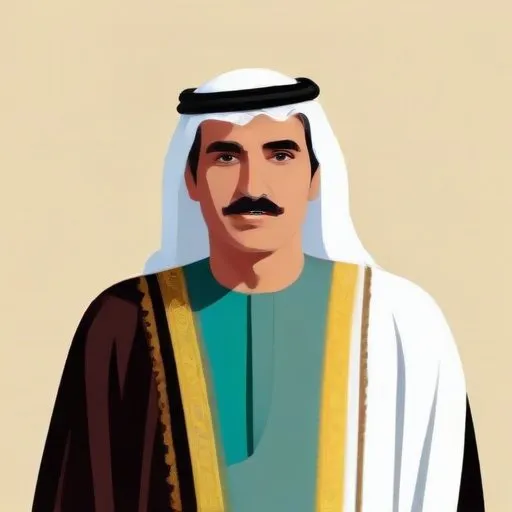
The 3rd Emir of Kuwait, ruling from 1977 to 2006, modernized the country's economy and infrastructure, while maintaining its independence and sovereignty. He's known for his diplomatic efforts and oil industry reforms.
Jaber AlAhmad AlSabah, the 13th ruler of the AlSabah dynasty, is remembered for his instrumental role in transforming Kuwait into a modern, prosperous nation. As the Emir of Kuwait from 1977 to 2006, he oversaw a period of unprecedented economic growth, socio-political reforms, and cultural development.
Born on June 29, 1926, in Kuwait City, Jaber AlAhmad AlSabah was the third son of Ahmad AlJaber AlSabah. He received his early education at AlMubarakiya School, AlAhmediya School, and AlSharqiya School, before being tutored privately in English, Arabic, religion, and the sciences.
In 1962, Jaber AlAhmad AlSabah was appointed as Kuwait's Minister of Finance, where he played a crucial role in introducing the Kuwaiti dinar and establishing the Kuwaiti Currency Board, of which he was the chair. He later became the Prime Minister of Kuwait before ascending to the throne in 1977.
During his reign, Jaber AlAhmad AlSabah implemented several reforms that transformed Kuwait's economy and society. Some of his notable achievements include:
Jaber AlAhmad AlSabah's life was marked by significant personal milestones, including the tragic loss of his brother, Fahad AlAhmed AlJaber AlSabah, who was killed in 1990 during the Gulf War.
Jaber AlAhmad AlSabah's vision and leadership had a profound impact on modern Kuwaiti society. He promoted a culture of tolerance, understanding, and cooperation, both within Kuwait and internationally.
Jaber AlAhmad AlSabah's reign was marked by significant regional and global events, including the Gulf War and the rise of globalization. Despite these challenges, he remained committed to his vision of a modern, prosperous Kuwait, earning him the respect and admiration of his people and the international community.
"Our goal is to make Kuwait a model of development and progress, where all citizens can live in dignity and prosperity."
Jaber AlAhmad AlSabah was awarded several honors for his outstanding service to Kuwait and the Arab world, including the Order of Mubarak the Great and the King Abdulaziz Medal.
Jaber AlAhmad AlSabah's life and legacy continue to inspire generations of Kuwaitis and Arabs around the world. His commitment to modernization, progress, and social welfare has left an indelible mark on the nation he loved and served.
97 Years Old
The Emir of Kuwait, ruling from 2006 to 2020, oversaw significant economic and infrastructure development, while also playing a key role in regional diplomacy and conflict resolution. He is remembered for his efforts to maintain stability and prosperity in the region.
64 Years Old
The King of Jordan, known for promoting peace and stability in the Middle East, and for being a key ally to Western nations.
90 Years Old
King of Jordan from 1952 to 1999, known for his efforts to modernize and stabilize the country, as well as his role in Middle Eastern politics.
Born in 1924
The sixth monarch of Saudi Arabia, known for his efforts to modernize the country and promote interfaith dialogue, while maintaining its traditional values and Islamic heritage.
