


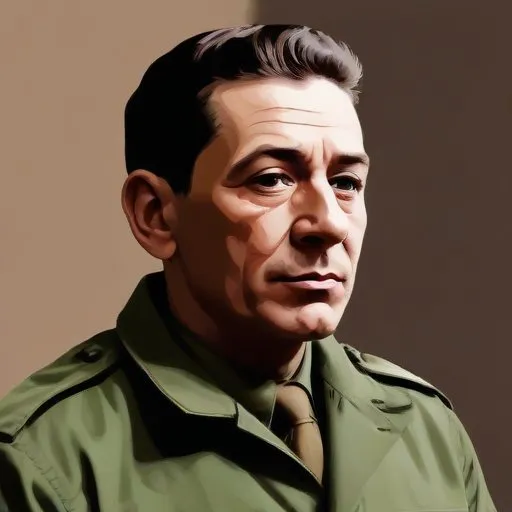
A social realist painter who depicted the struggles of the working class and the corruption of the powerful, known for his bold and expressive works that critiqued American society.
Known for his biting satires on modern life, political corruption, and biblical narratives, Jack Levine was a prominent American Social Realist painter and printmaker of the 20th century. His work, characterized by its stark realism and biting wit, continues to resonate with audiences today, offering a scathing critique of the social ills of his time.
Born on January 3, 1915, to Lithuanian Jewish immigrants Samuel and Mary Levine, Jack grew up in the South End of Boston, where the streets were lined with European immigrants and the echoes of poverty and societal ills. It was here that his mother, Mary, encouraged his early artistic endeavors, storing his art materials in the family kitchen and nurturing his talent.
In 1924, Levine began his formal artistic education under the guidance of artist and educator Harold K. Zimmerman at the Jewish Welfare Center in Roxbury, where he would study until 1931. During this period, he met fellow artist Hyman Bloom, with whom he would later study under Denman Ross at Harvard University from 1929 to 1933.
Levine's early work was heavily influenced by the likes of Hyman Bloom, Cham Soutine, Georges Rouault, and Oskar Kokoschka. Alongside Bloom and Karl Zerbe, he would become a key figure in the Boston Expressionist movement, a style characterized by its bold colors, distorted forms, and intense emotional depth.
In 1932, Ross included Levine's drawings in an exhibition at the Fogg Art Museum at Harvard, and three years later, bequeathed twenty of Levine's drawings to the museum's collection. This early recognition would pave the way for Levine's future success, solidifying his position as a rising star in the art world.
From 1935 to 1940, Levine worked for the Works Progress Administration, a federal agency established to provide relief to artists during the Great Depression. During this period, he honed his skills as a satirist, using his art to critique the social and political ills of his time.
In 1936, Levine held his first solo exhibition of paintings in New York City, marking a turning point in his career. The exhibition, titled "New Horizons in American Art," showcased his unique brand of satire, which would become a hallmark of his work.
Today, Jack Levine is recognized as one of the most important American artists of the 20th century, his work spanning genres from satire to biblical narrative. His legacy extends far beyond his own artistic output, influencing generations of artists, from the Abstract Expressionists to contemporary satirists.
Levine's work continues to resonate with audiences today, offering a scathing critique of modern life and the systems that govern it. As a testament to his enduring impact, his work can be found in the permanent collections of major institutions, including the Museum of Modern Art, the Whitney Museum of American Art, and the Fogg Art Museum at Harvard University.
Throughout his long and distinguished career, Jack Levine remained true to his artistic vision, using his work to critique the social and political ills of his time. Today, his legacy serves as a testament to the power of art to shape our understanding of the world around us.
Born in 1885
A pioneer of American modernism, this artist's bold, flat forms and vibrant colors paved the way for Abstract Expressionism. Their work bridges representation and abstraction, exploring the emotional depth of everyday life.
Born in 1913
A prominent abstract artist and educator, known for his bold, geometric paintings that explored the spiritual and emotional potential of art. He also wrote extensively on art theory and criticism.
Born in 1903
A pioneer of abstract expressionism, creating bold, rectangular color fields that evoke emotions and spark introspection. His works are a testament to the power of art to transcend language and culture.
Born in 1905
A pioneer of Abstract Expressionism, creating bold, color-field paintings that evoke emotions and spirituality. His iconic "zip" paintings feature vibrant, vertical stripes that seem to pulse with energy.
Born in 1904
A pioneering abstract expressionist, creating large-scale, gestural paintings that explored the human experience and the American West. Known for his bold, expressive brushstrokes and vibrant color palette.
Born in 1925
A pioneer of pop art, combining found objects and images to create innovative, thought-provoking works that blurred the lines between art and everyday life.
96 Years Old
A pioneer of pop art, creating enigmatic works that explore the relationship between perception, reality, and meaning, often using common images like flags and targets.
Born in 1882
A pioneering realist artist capturing the essence of modern American life through poignant, cinematic scenes of urban isolation and melancholy, evoking a sense of nostalgia and quiet contemplation.
