


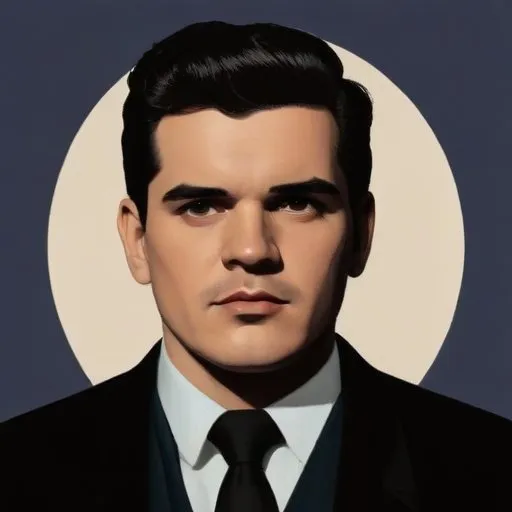
A pioneer in rocket propulsion and occult practices, blending science and mysticism to push boundaries in both fields. Known for his contributions to jet propulsion and his unconventional spiritual pursuits.
Jack Parsons, a name synonymous with innovation and controversy, is best known for his pioneering work in rocket propulsion and his unorthodox association with the occult. As a co-founder of the Jet Propulsion Laboratory (JPL) and a prominent figure in the development of solid-fuel rockets, Parsons left an indelible mark on the aerospace industry.
Parsons' fascination with rocketry and the occult began at an early age. He was captivated by the works of science fiction author H.P. Lovecraft and delved deep into the realm of mysticism, joining the Ordo Templi Orientis (OTO), a religious organization founded by Aleister Crowley. This unlikely combination of interests would shape Parsons' life and work, ultimately leading to both groundbreaking achievements and tumultuous relationships.
Parsons' involvement with the OTO and his fascination with the occult led him to develop a unique philosophical perspective. He believed in the power of the individual to shape reality and saw his work in rocketry as a means to transcend the limitations of humanity. This vision was reflected in his concept of the " rocket as phallic symbol," which symbolized the union of technology and mysticism.
Parsons' innovations in rocket propulsion paved the way for the development of modern space exploration. His work at JPL laid the foundation for NASA's space program, and his solid-fuel rockets remain a crucial component of many space missions. Beyond the realm of science, Parsons' unorthodox approach to life and his fusion of technology and mysticism continue to inspire artists, writers, and visionaries.
Parsons' affiliation with the occult and his perceived "deviance" from societal norms led to his marginalization by the mainstream scientific community. His tumultuous relationships and unexplained death further solidified his reputation as an enigmatic figure, shrouded in mystery and controversy.
"I believe in one thing – the power of man to create his own destiny."
Through his extraordinary life and work, Jack Parsons continues to captivate and inspire, leaving behind a legacy that transcends the boundaries of science, mysticism, and art. As we gaze up at the stars, we are reminded of the turbulent life of a man who dared to defy convention and push the limits of human imagination.
Born in 1875
A renowned occultist and mystic who wrote extensively on magic, mysticism, and thelema, and is often associated with the phrase "Do what thou wilt shall be the whole of the Law."
Born in 1911
Creator of the self-help religion Scientology, known for his science fiction writings and controversial teachings on spirituality and personal development.
Born in 1907
Pioneering science fiction author and screenwriter who penned influential classics like "Stranger in a Strange Land" and "Starship Troopers", exploring complex social and philosophical themes.
Born in 1920
A renowned science fiction author and biochemistry professor who wrote or edited more than 500 books and an estimated 90,000 letters and postcards throughout his lifetime.
Born in 1917
Pioneering science fiction author who wrote prophetic and imaginative novels, such as "2001: A Space Odyssey", that explored the intersection of technology and humanity.
Born in 1912
Developed the V-2 rocket for Nazi Germany and later led the team that created the Saturn V rocket that took humans to the moon.
Born in 1907
A pioneering rocket engineer and designer who played a crucial role in the Soviet space program, developing the R-7 rocket that launched Sputnik and sent humans into space.
Born in 1857
Pioneering rocket scientist and engineer who developed the theoretical foundations of modern astronautics, including the concept of multistage rockets and space exploration.
