


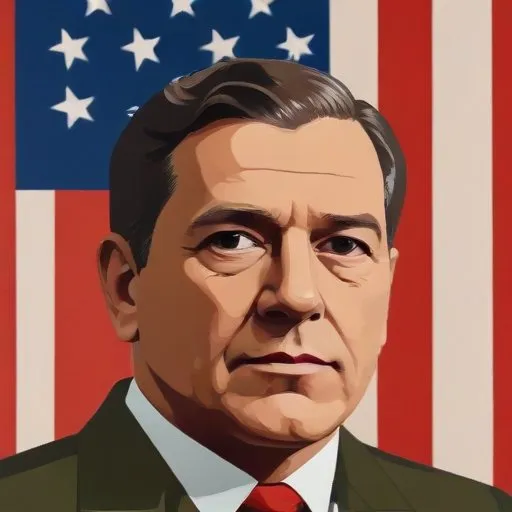
A prominent attorney general and politician who played a significant role in shaping New York's legal landscape and advocating for liberal policies. He's most known for his efforts in civil rights and social justice.
Jacob K. Javits, a four-term United States Senator from New York, is best known for his relentless advocacy for liberal causes, commitment to environmental protection, and instrumental role in shaping America's foreign policy.
Throughout his illustrious career, Javits championed progressive legislation, earning him the reputation as a vocal critic of government excess and a steadfast defender of individual rights.
Born on May 18, 1904, in New York City, Javits grew up in a poor Jewish family, instilling in him a deep appreciation for the value of hard work and the importance of social justice.
After graduating from Columbia University Law School, Javits began his legal career, eventually serving as a lieutenant commander in the United States Army during World War II.
Javits' political career spanned over three decades, marked by his unwavering commitment to progressive ideals and his unshakeable optimism in the face of adversity.
He served in the U.S. House of Representatives from 1947 to 1954 and later in the U.S. Senate from 1957 to 1981, where he became a leading voice on foreign policy, national security, and environmental issues.
Javits was a pioneering advocate for environmental protection, introducing landmark legislation to preserve America's natural resources and promote sustainable development.
In 1965, he co-sponsored the National Environmental Policy Act, which established the foundation for modern environmental policy and paved the way for subsequent environmental legislation.
Javits played a significant role in shaping America's foreign policy, serving as a key advisor to several U.S. presidents, including John F. Kennedy and Lyndon B. Johnson.
He was a strong supporter of international cooperation, advocating for human rights, arms control, and conflict resolution. His leadership on the Senate Foreign Relations Committee helped to shape U.S. policy on critical global issues.
Javits' personal life was marked by both triumph and tragedy. He married Marion Ann Borinstein in 1933, and together they had three children.
In 1979, Javits was diagnosed with amyotrophic lateral sclerosis (ALS), a debilitating neurological disease that ultimately claimed his life on March 7, 1986.
Jacob K. Javits' legacy extends far beyond his impressive political resume. He embodies the spirit of progressive politics, inspiring generations of leaders to strive for a more just and equitable society.
Today, his commitment to environmental protection, social justice, and human rights continues to inspire and motivate Americans to work towards a better world.
"The only way to make sense out of change is to plunge into it, move with it, and join the dance."
"We must not be afraid to take a stand, even if it means standing alone."
Jacob K. Javits' remarkable life and unwavering dedication to public service have left an indelible mark on American politics and the world at large.
As we reflect on his remarkable legacy, we are reminded of the power of individual commitment to creating a better world for all.
Born in 1908
A wealthy businessman and politician who served as Vice President under Gerald Ford, known for his moderate Republican views and influential role in shaping US foreign policy.
Born in 1925
A Navy officer, lawyer, and politician who served as US Attorney General, playing a key role in the Civil Rights Movement and advocating for social justice. He was a prominent figure in American politics during the 1960s.
94 Years Old
A prominent figure in American politics, serving nearly 47 years in the Senate, championing liberal causes, and playing a significant role in shaping the country's healthcare and civil rights policies.
Born in 1911
The 38th Vice President of the United States was a prominent liberal politician and journalist who played a key role in shaping the country's civil rights policies. He's most known for his strong support of the Civil Rights Act of 1964.
Born in 1908
The 36th President of the United States, a skilled politician and leader, played a crucial role in passing landmark civil rights legislation, including the Civil Rights Act and Voting Rights Act.
Born in 1913
The 37th President of the United States, a polarizing figure who led the country through significant domestic and foreign policy changes, infamous for his involvement in the Watergate scandal.
Born in 1918
The 39th Vice President of the United States, a politician embroiled in scandal, resigning amidst corruption charges, forever tainting his legacy. He's infamous for being the first VP to resign due to criminal conduct.
Born in 1913
The 38th President of the United States, a former football star and lawyer, is known for being the first vice president to assume the presidency under the 25th Amendment and for his controversial pardon of Richard Nixon. He's also remembered for his humble and accidental rise to the presidency.
