


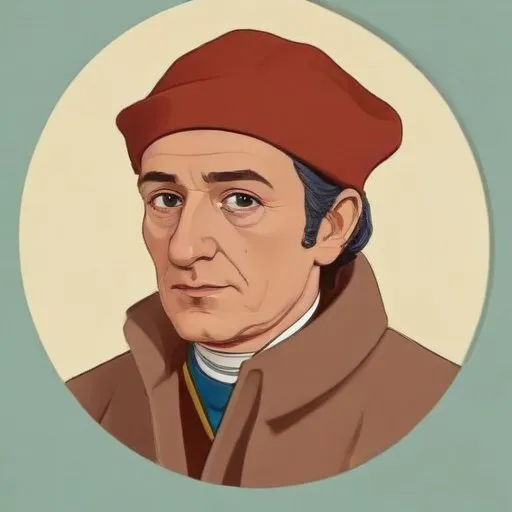
A French archaeologist and author who discovered and wrote about ancient human remains and artifacts, shedding light on prehistoric human life. His findings greatly advanced the field of archaeology.
Jacques Boucher de Crèvecœur de Perthes, a French archaeologist and antiquary, is renowned for his groundbreaking discovery of flint tools in the Somme Valley around 1830. This pivotal finding marked a significant milestone in the field of prehistoric archaeology, propelling our understanding of human existence during the Stone Age.
Born on September 10, 1788, in Rethel, Ardennes, Jacques was the eldest son of Jules Armand Guillaume Boucher de Crèvecœur, a botanist and customs officer, and Étienne-Jeanne-Marie de Perthes. By royal decree in 1818, Jacques was authorized to assume his mother's surname in addition to his father's. He entered government employ as an officer of customs in 1802, which took him to Italy for six years. Upon his return in 1811, he enjoyed rapid promotion, eventually becoming the director of the douane (customs office) at Abbeville in 1825, a position he held for the rest of his life.
During his leisure time, Jacques devoted himself to studying the Stone Age and antediluvian man. His passion led him to discover, in the Somme Valley, flints that bore evidence of human handiwork around 1830. However, it wasn't until 1846 that he made public his significant finding of a worked flint implement alongside remains of elephant and rhinoceros in the gravels of Menchecourt. This discovery paved the way for his monumental three-volume work, Antiquités celtiques et antédiluviennes, published starting in 1847.
Through his work, Jacques established the existence of man in the Pleistocene or early Quaternary period, a concept that was met with initial skepticism. Despite facing criticism for his earlier theories and poorly executed illustrations, Jacques' findings ultimately opened doors to a new era in understanding human history, solidifying his position as a pioneer in the field of prehistoric archaeology.
Jacques' contributions to archaeology have had a lasting impact on our understanding of humanity's past. His work has inspired generations of archaeologists, anthropologists, and historians, shaping the course of research and discovery in these fields. Today, his name is synonymous with groundbreaking discoveries that have rewritten the history books.
Jacques Boucher de Crèvecœur de Perthes' legacy serves as a testament to the power of curiosity, perseverance, and dedication to uncovering the secrets of our collective past. His remarkable contributions continue to inspire and educate us, shaping our understanding of humanity's rich and fascinating history.
Born in 1881
A French priest who merged spirituality with science, exploring the intersection of faith and evolution, and proposing a cosmic vision of human destiny. He's famous for his book "The Phenomenon of Man".
Born in 1744
A French soldier, biologist, and academic who developed a theory of inheritance of acquired characteristics, proposing that organisms adapt to their environment and pass on those traits to their offspring.
Born in 1769
Founded the field of comparative anatomy, establishing extinction as a fact and creating a framework for understanding the natural world through fossil records.
Born in 1775
A pioneer in the field of electromagnetism, he formulated fundamental laws that describe the relationship between electric currents and magnetic fields. His work laid the foundation for many modern technologies, including electric motors and generators.
Born in 1774
A French polymath who made significant contributions to the fields of physics, astronomy, and mathematics, particularly in the discovery of chromatic polarization and the Biot-Savart law.
Born in 1797
A Scottish geologist who pioneered the concept of uniformitarianism, which states that the Earth's geological features were shaped by slow, gradual processes over millions of years. His work laid the foundation for modern geology and influenced Charles Darwin's theory of evolution.
