


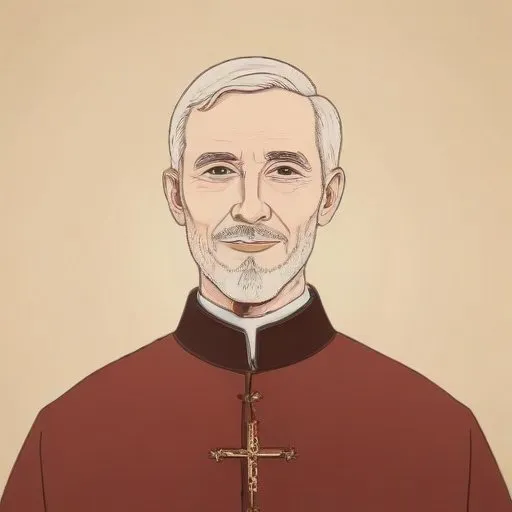
A Swiss clergyman and botanist who studied and classified numerous plant species, contributing significantly to the field of botany. His work remains valuable for understanding plant diversity and classification.
Jacques Denys Choisy was a Swiss Protestant clergyman and botanist, best known for his significant contributions to the field of botany, particularly in the publication of Prodromus Systematis Naturalis Regni Vegetabilis, a pioneering work on plant classification. His groundbreaking research and dedication to the field earned him recognition, with the botanical genus Choisya family Rutaceae being named in his honor.
Born on April 5, 1799, in Jussy, Choisy pursued his studies in theology, law, humanities, and sciences at the Academy of Geneva. In 1821, he became ordained as a minister and furthered his education in Paris, where he was accepted as a member of the Société d'histoire naturelle.
Choisy's passion for botany was ignited under the influence of Augustin Pyramus de Candolle, a renowned Swiss botanist. He went on to become a principal contributor to Candolle's publication of Prodromus Systematis Naturalis Regni Vegetabilis, authoring sections on plant families such as Marcgraviaceae, Convolvulaceae, Hydroleaceae, Selaginaceae, Nyctaginaceae, Hypericineae, and Guttiferae. His own botanical works include:
In addition to his botanical pursuits, Choisy was a theologian and philosopher. He published works such as:
Choisy's contributions to botany and theology have left an indelible mark on the scientific community. The botanical genus Choisya family Rutaceae, named in his honor, serves as a testament to his dedication and expertise. His works continue to inspire and influence future generations of botanists and theologians.
Choisy's life was marked by significant milestones, including his ordination as a minister in 1821 and his appointment as chair of rational philosophy at the Academy of Geneva, a position he held until 1847.
Jacques Denys Choisy's remarkable life and legacy serve as a reminder of the importance of interdisciplinary pursuits and the impact one individual can have on multiple fields of study.
Born in 1712
A pioneering thinker who shaped modern democracy and education with his ideas on social contracts, general will, and the importance of early childhood education. His writings influenced the French Revolution and modern political thought.
Born in 1694
A witty and insightful 18th-century writer and philosopher who used satire to critique societal norms and advocate for reason, tolerance, and human rights.
Born in 1717
A French Enlightenment thinker who made significant contributions to mathematics, physics, and philosophy, particularly in the fields of fluid dynamics and the study of vibrating strings. He's also known for his work on the Encyclopedia, a comprehensive reference work that aimed to compile all knowledge of the time.
Born in 1749
Developed nebular hypothesis of the origin of the solar system and formulated Laplace's equation, a fundamental concept in mathematics and physics. He's considered the founder of celestial mechanics.
Born in 1743
Father of modern chemistry, discovered oxygen, and developed a systematic method of chemical nomenclature. He laid the foundation for modern chemistry and paved the way for future scientific discoveries.
Born in 1707
Developed the system of binomial nomenclature, which is still used today to classify and name living organisms. This system has had a profound impact on the fields of biology, ecology, and conservation.
Born in 1744
A French soldier, biologist, and academic who developed a theory of inheritance of acquired characteristics, proposing that organisms adapt to their environment and pass on those traits to their offspring.
