


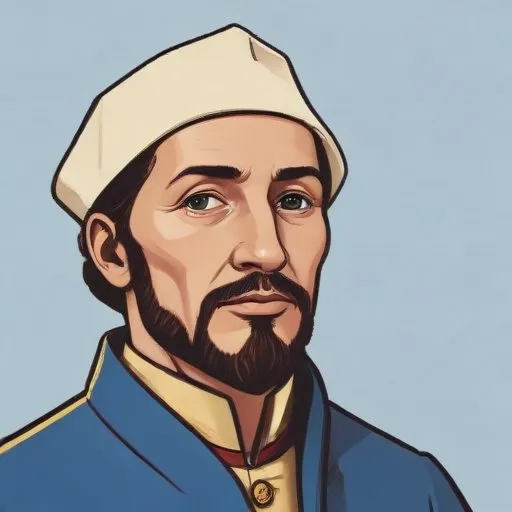
French missionary and explorer who established missions in the Great Lakes region and mapped many of its rivers and lakes, including the Mississippi River. He played a key role in the European exploration of North America.
Jacques Marquette, a French Jesuit missionary, is renowned for being the first European to explore and map the northern portion of the Mississippi River Valley, alongside Louis Jolliet in 1673. This groundbreaking expedition positioned Marquette as a pioneer in American exploration, and his legacy continues to inspire wonder and awe.
Born on June 1, 1637, in Laon, France, Marquette was the third of six children to Rose de la Salle and Nicolas Marquette, a wealthy merchant family. The Marquettes were respected for their military and civil service, which likely influenced Jacques' desire to serve others.
At the tender age of 9, Marquette began his education at the Jesuit College in Reims, where he remained until joining the Society of Jesus at 17. He went on to teach and study philosophy at various institutions, including Auxerre, Reims, Charleville, and Langres, until 1665. During this time, Marquette repeatedly requested to be sent on missionary work, driven by his passion to spread the Gospel.
In 1665, Marquette's desire for missionary work was finally fulfilled when he was assigned to the Jesuit mission in New France, specifically to work with the Five Nations. After his ordination on March 7, 1666, he arrived in Quebec on September 20, ready to embark on his new calling.
Marquette's first posting was at the mission of Saint Michel at Sillery, where he immersed himself in the languages and customs of the Algonquin, Abenaki, and Iroquois people. He later assisted Gabriel Druillettes at Trois-Rivières on the Saint Lawrence River, further refining his understanding of the indigenous populations.
In 1673, Marquette teamed up with Louis Jolliet, an explorer from Quebec City, to venture into the unknown. Their journey took them down the Mississippi River, making them the first Europeans to explore and map the northern portion of the river valley. This daring expedition opened up new territories for French colonization and sparked a deeper understanding of the region's geography.
Marquette's missionary work did not stop at exploration. In 1668, he founded Michigan's first European settlement, Sault Sainte Marie, and later established Saint Ignace in 1671. These settlements served as hubs for Jesuit missionary work, allowing Marquette to continue his pursuit of spreading Christianity to the indigenous populations.
Jacques Marquette's remarkable life and achievements have left an indelible mark on American history. His fearlessness, dedication to his faith, and commitment to understanding the Native American populations have inspired generations of explorers, missionaries, and scholars.
Jacques Marquette's remarkable story serves as a reminder of the importance of cultural understanding, perseverance, and devotion to one's calling. His life's work has inspired countless individuals to pursue careers in exploration, missionary work, and education, ensuring that his legacy continues to flourish.
Born in 1567
French explorer who mapped much of eastern North America, establishing trade and settlement in what is now Canada and the northeastern United States.
Born in 1626
The first Intendant of New France was a key figure in establishing and governing the French colony, overseeing its economic development, and implementing policies to ensure its growth and prosperity. They played a crucial role in shaping the colony's early years.
Born in 1645
French-Canadian explorer who charted the Mississippi River and claimed the region for France, opening up the Midwest to further exploration and settlement.
