


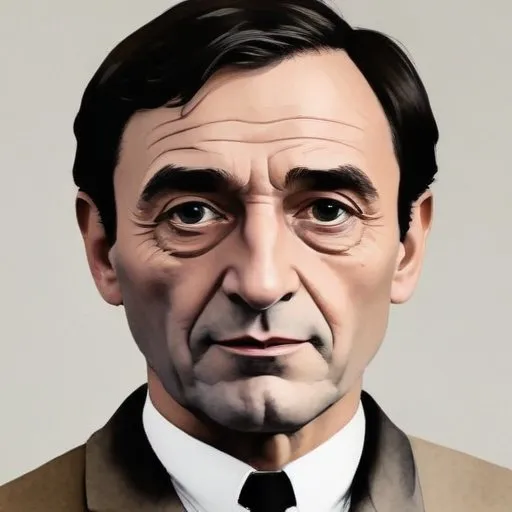
A French anthropologist and politician who studied and wrote extensively on Aztec and Mayan civilizations, and later served as Governor-General of Algeria.
Jacques Soustelle, a French anthropologist, politician, and intellectual, is best known for his pivotal role in the Free French Forces during World War II, his governance of Algeria, and his groundbreaking work in Pre-Columbian civilizations.
Soustelle was born on February 3, 1912, in Montpellier, France, to a Protestant working-class family. He demonstrated exceptional academic prowess, gaining admission to the prestigious École Normale Supérieure de la rue d'Ulm. At just 20 years old, he ranked first in the competitive exam of agrégation de philosophie, a high-level grade for teaching.
Soustelle's interest in ethnology was sparked while working at the Musée de l'Homme under Paul Rivet. Rivet sent him to Mexico to study the Otomi people, where he wrote his first major book, Mexique, Terre Indienne (Mexico is Indian). Soustelle was an ardent antifascist, serving as the general secretary of the French Union of Intellectuals against Fascism in 1935.
After the Armistice of 22 June 1940, Soustelle left Mexico to join the Free French Forces (FFL) in London. Charles de Gaulle entrusted him with a diplomatic mission in Latin America in 1941, aiming to establish support committees for Free France and counter the diplomatic efforts of the Pétainists throughout the continent. He headed the intelligence service Bureau Central, solidifying his position as a key figure in the Resistance.
Soustelle served as Governor-General of Algeria from 1955 to 1957, where he opposed any compromise with anticolonial activists. His stance led to a rift with De Gaulle, and he was eventually forced into exile between 1961 and 1968 after joining the Organisation de l'Armée Secrète (OAS) in their efforts to overthrow De Gaulle.
Upon his return to France, Soustelle resumed his academic and political pursuits. He was elected to the Académie française in 1983, cementing his reputation as a renowned intellectual.
Jacques Soustelle's life was marked by controversy, rebellion, and unwavering dedication to his beliefs. His contributions to anthropology, particularly in the field of Pre-Columbian civilizations, are still revered today. Though his political stance on Algerian independence was divisive, his courage and conviction inspire admiration.
In conclusion, Jacques Soustelle's extraordinary life serves as a testament to the power of conviction, intellectual curiosity, and the pursuit of freedom and justice.
Born in 1908
A founder of modern anthropology, known for structuralism and deciphering the underlying patterns of human culture and society. His work bridges the gap between sociology, psychology, and philosophy.
Born in 1896
French poet and author who founded Surrealism, a cultural movement that explored the subconscious and the world of dreams. He wrote novels, poems, and essays that continue to influence art and literature today.
Born in 1905
Existentialist philosopher and playwright who argued that humans have complete freedom to choose their actions and create their own meaning in life, influencing modern thought on morality and individual responsibility.
Born in 1908
A pioneering feminist philosopher who wrote extensively on ethics, politics, and gender, famously arguing that "one is not born, but rather becomes, a woman."
Born in 1913
A French novelist, philosopher, and journalist who wrote influential works like "The Stranger" and "The Plague", exploring absurdism and the human condition.
Born in 1916
A French lawyer and politician who served as the 21st President of France, known for his socialist policies and role in shaping the European Union. He's also remembered for his controversial past and complex personality.
Born in 1911
A French banker-turned-politician who served as President of France from 1969 to 1974, known for modernizing the country's economy and infrastructure. He's also famous for commissioning the iconic Pompidou Center in Paris.
96 Years Old
A French sociologist, anthropologist, and philosopher who developed the concept of "cultural capital" and critiqued social inequality, highlighting how power and privilege are maintained through cultural and symbolic means.
