


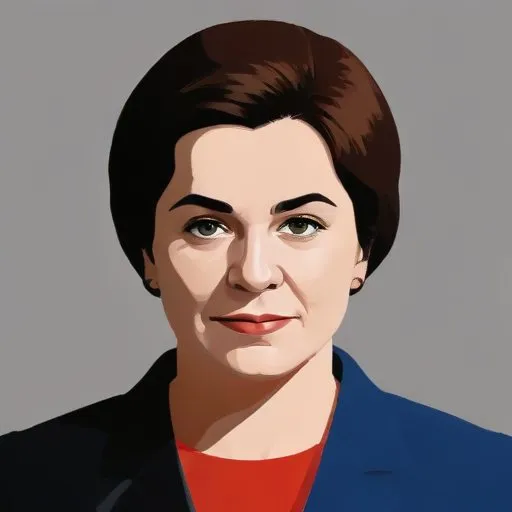
Croatia's first female Prime Minister, serving from 2009 to 2011, known for her efforts to reform the country's economy and politics. She was also a prominent journalist and politician before taking office.
Jadranka Kosor, a Croatian politician and former journalist, etched her name in history as the first and, to date, only woman to assume the role of Prime Minister of Croatia, serving from 2009 to 2011. Her tenure marked a significant milestone in the country's political landscape, as she navigated the nation through a period of economic uncertainty and political upheaval.
Kosor's journey to the pinnacle of Croatian politics began with a career in journalism. Following her graduation from the Zagreb Faculty of Law, she worked as a journalist, eventually hosting a radio show focused on refugee problems and disabled war veterans during the Croatian War of Independence. This experience instilled in her a deep understanding of the nation's most pressing concerns, which would later inform her policy decisions as a politician.
In 1989, Kosor joined the center-right Croatian Democratic Union (HDZ), rapidly ascending through the party's ranks. Her leadership skills and political acumen earned her the position of party vice-president in 1995, as well as a seat in Parliament. Following the death of President Franjo Tuđman, Kosor supported Ivo Sanader's successful bid for party leadership in 2000, further solidifying her position within the HDZ.
As Minister of Family, Veterans Affairs, and Intergenerational Solidarity in Sanader's first and second cabinets, Kosor was instrumental in shaping the nation's social welfare policies. Her ministry focused on providing support to refugees, disabled war veterans, and families, earning her a reputation as a compassionate and dedicated public servant.
In 2005, Kosor ran as the HDZ candidate in the presidential election, ultimately losing to incumbent President Stjepan Mesić in the second round. However, her party's victory in the 2007 parliamentary election paved the way for her to assume the role of Minister of Family, Veterans Affairs, and Intergenerational Solidarity, as well as Deputy Prime Minister.
Following Ivo Sanader's sudden resignation in 2009, Kosor managed to form a functioning parliamentary majority, becoming the first female Prime Minister of Croatia. Her leadership during this period was marked by a series of budget revisions, aimed at preventing the country's budgetary meltdown. Despite these efforts, her party lost the 2011 general election, and Kosor handed power to Zoran Milanović in December 2011.
Kosor's premiership, although marked by challenges, has left an indelible mark on Croatian politics. Her leadership and commitment to public service have inspired a generation of women to pursue careers in politics, paving the way for greater gender equality in the country's political sphere.
Kosor's premiership coincided with a period of significant social and economic change in Croatia. Her leadership and policy decisions have had a lasting impact on the nation's social welfare, family, and veteran support services, cementing her legacy as a champion of public service and social justice.
73 Years Old
A Croatian historian and politician who served as the 8th Prime Minister of Croatia, known for his role in the country's accession to the European Union and his later corruption scandal.
91 Years Old
Croatia's second president, a key figure in the country's independence and transition to democracy, known for his role in shaping modern Croatia's political landscape.
Born in 1922
First President of Croatia, leading the country to independence from Yugoslavia, and known for his role in shaping modern Croatian identity.
