


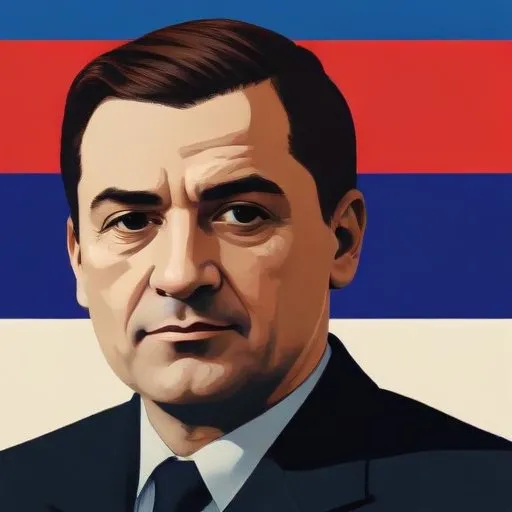
A Croatian historian and politician who served as the 8th Prime Minister of Croatia, known for his role in the country's accession to the European Union and his later corruption scandal.
Ivo Sanader, born on June 8, 1953, is a former Croatian politician who served as Prime Minister of Croatia from 2003 to 2009, making him the second longest-serving prime minister since Croatia's independence. Throughout his political career, Sanader was known for his dominant role in the Croatian Democratic Union (HDZ) party, leading it to victory in two consecutive general elections.
Sanader obtained his education in comparative literature in Austria, where he also worked as a journalist, in marketing, and publishing, and as an entrepreneur. These diverse experiences likely shaped his future political endeavors and leadership style.
In the 1990s, Sanader briefly served as the intendant of the Croatian National Theatre in Split before becoming Minister for Science and Technology in the cabinet of Hrvoje Šarinić in 1992. He then moved into diplomacy, serving two terms as Deputy Minister for Foreign Affairs.
Following the death of Franjo Tuđman, Sanader was elected president of the HDZ in 2000, and again in 2002, leading the party to victory in the 2003 and 2007 elections. This marked the beginning of his prime ministership, which lasted for over five and a half years.
In June 2009, Sanader abruptly resigned his post, leaving scarce explanation for his actions and disappearing from public life for a while. In January 2010, he attempted to stage a political comeback within the HDZ but was ejected from party membership.
In December 2010, Croatian authorities indicted Sanader in two high-profile corruption cases. He fled the country but was apprehended in Austria and extradited to Croatia in July 2011. Sanader was subsequently sentenced to prison for corruption and is currently serving a prison sentence in Lipovica prison.
Despite his controversial exit from politics, Sanader's legacy as a dominant figure in Croatian politics remains. He is one of only two Croatian prime ministers, along with Andrej Plenković, who have served more than one term. Sanader's leadership style and political maneuvers have been the subject of much debate and speculation.
Throughout his political career, Sanader's beliefs and ideologies were shaped by his party's conservative and nationalist leanings. His leadership style was often criticized for being authoritarian and centralizing power. Despite this, Sanader's commitment to his party and its ideals remained unwavering.
Sanader's time in office had a lasting impact on Croatian society, with his government implementing several key reforms, including accession to the European Union. His legacy, however, is marred by the corruption allegations that led to his downfall.
Sanader's sudden resignation, corruption allegations, and subsequent imprisonment have led to widespread criticism and scrutiny. His once-dominant position in Croatian politics has been tarnished, and his legacy remains controversial.
By examining Sanader's life and career, we gain insight into the complexities of Croatian politics and the challenges faced by its leaders. Despite his flaws, Sanader's impact on Croatian society and politics remains undeniable.
Born in 1922
First President of Croatia, leading the country to independence from Yugoslavia, and known for his role in shaping modern Croatian identity.
83 Years Old
A Croatian lawyer and politician who served as the 16th Speaker of the Croatian Parliament, known for his contributions to the country's political landscape and legislative reforms.
82 Years Old
The 7th Prime Minister of Croatia, a key figure in the country's transition to democracy and EU integration, known for his efforts to rebuild and stabilize the nation after a devastating war.
91 Years Old
Croatia's second president, a key figure in the country's independence and transition to democracy, known for his role in shaping modern Croatia's political landscape.
73 Years Old
Croatia's first female Prime Minister, serving from 2009 to 2011, known for her efforts to reform the country's economy and politics. She was also a prominent journalist and politician before taking office.
