


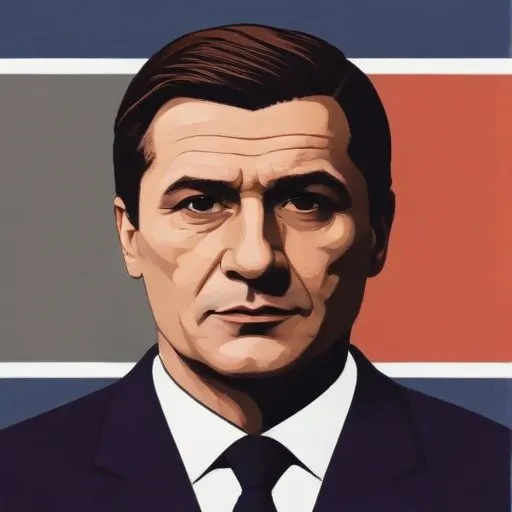
The 7th Prime Minister of Croatia, a key figure in the country's transition to democracy and EU integration, known for his efforts to rebuild and stabilize the nation after a devastating war.
Ivica Račan was a prominent Croatian politician who served as the Prime Minister of Croatia from 2000 to 2003, leading two centre-left coalition governments. He was the first Prime Minister of Croatia not to be a member of the Croatian Democratic Union (HDZ), marking a significant shift in the country's political landscape.
Raćan was born on February 24, 1944, in Ebersbach, Nazi Germany, where his mother Marija Draženović was interned in a labor camp during World War II. He and his mother survived the Allied bombing of Dresden and were buried for days in the basement of a collapsed building. After the war, Račan returned to Croatia and spent his childhood and adolescence in Slavonski Brod, before moving to Zagreb and enrolling at the University of Zagreb. In 1970, he graduated from the Zagreb Faculty of Law.
Raćan entered politics in 1961 as a member of the League of Communists of Croatia (SKH), the Croatian branch of the League of Communists of Yugoslavia (SKJ). He was president of the communist youth organization in the Slavonski Brod gymnasium. From 1963 to 1974, he worked for the Yugoslav Institute of Social Research, where he studied and researched the topic of Workers' self-management.
In 1990, Račan became the leader of the reformed SKH, which later became the Social Democratic Party of Croatia (SDP). He served as the Leader of the Opposition on two occasions: firstly, from the first multiparty elections in May 1990 until the formation of a national unity government under Franjo Tuđman in July 1991, and secondly, from his defeat in the 2003 general election by Ivo Sanader until his death on April 29, 2007.
In 2000, Račan's SDP won the parliamentary election, and he became the Prime Minister of Croatia, heading a centre-left coalition government. During his tenure, he implemented several reforms, including the decentralization of power, the strengthening of local government, and the promotion of civil society. He also played a crucial role in Croatia's accession to the European Union.
Raćan's legacy is marked by his commitment to democracy, social justice, and European integration. He was a strong advocate for human rights and the rule of law, and he worked tirelessly to promote Croatia's integration into the European Union. Despite facing challenges and controversies during his political career, Račan remains a respected figure in Croatian politics, known for his integrity, wisdom, and vision.
Raćan was married to Jadranka Račan, and they had two children together. He was a passionate supporter of the Croatian football team and enjoyed reading literature and listening to classical music. Račan was also known for his love of nature and the outdoors, and he often spent his free time hiking and fishing.
Raćan's life and legacy serve as a testament to his dedication to democracy, social justice, and European integration. His contributions to Croatian politics and society continue to inspire and influence future generations of leaders and citizens alike.
91 Years Old
Croatia's second president, a key figure in the country's independence and transition to democracy, known for his role in shaping modern Croatia's political landscape.
73 Years Old
A Croatian historian and politician who served as the 8th Prime Minister of Croatia, known for his role in the country's accession to the European Union and his later corruption scandal.
73 Years Old
Croatia's first female Prime Minister, serving from 2009 to 2011, known for her efforts to reform the country's economy and politics. She was also a prominent journalist and politician before taking office.
73 Years Old
A Croatian Deputy Prime Minister and sociologist who advocated for social justice, women's rights, and democratic values. She played a key role in shaping Croatia's post-war development and EU integration.
83 Years Old
A Croatian lawyer and politician who served as the 16th Speaker of the Croatian Parliament, known for his contributions to the country's political landscape and legislative reforms.
