


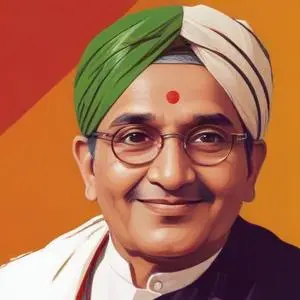
The 4th Deputy Prime Minister of India, a key figure in the country's struggle for independence and a champion of social justice, known for his tireless work in uplifting the marginalized.
Jagjivan Ram, affectionately known as Babuji, was a trailblazing Indian independence activist and politician who dedicated his life to fighting for the rights of the marginalized and oppressed. He is renowned for his instrumental role in shaping India's social justice landscape, particularly through his contributions to the Constitution and his unwavering commitment to the dalit community.
Born on April 5, 1908, in Chandwa liability, Arrah, Bihar, Jagjivan Ram hailed from the Chamar caste, one of the most oppressed communities in the Indian caste system. Despite the challenges he faced, he pursued his education with determination, eventually earning a degree in law from Banaras Hindu University.
In 1935, Jagjivan Ram founded the All India Depressed Classes League, an organization dedicated to attaining equality for dalits. This marked the beginning of his lifelong struggle against social inequality and oppression. He was elected to the Bihar Legislative Assembly in 1937, and his tireless efforts to organize the rural labor movement earned him recognition as a leader in the fight for social justice.
In 1946, Jagjivan Ram became the youngest minister in Jawaharlal Nehru's interim government, serving as the Labor Minister and a member of the Constituent Assembly of India. During this period, he played a crucial role in ensuring that social justice was enshrined in the Indian Constitution. Over the next 30 years, he held various ministerial portfolios, leaving an indelible mark on Indian politics.
Jagjivan Ram's leadership during the Indo-Pak war of 1971, as the Defence Minister of India, was instrumental in the creation of Bangladesh. His strategic vision and courage played a significant role in shaping the course of Indian history.
As the Union Agriculture Minister, Jagjivan Ram spearheaded India's Green Revolution, modernizing Indian agriculture and ensuring food security for the nation. His contributions during the 1974 drought, when he held the additional portfolio, are still remembered and revered.
Though Jagjivan Ram initially supported Prime Minister Indira Gandhi during the Emergency (1975-1977), he later broke away from the Congress party and joined the Janata Party alliance. This brave move was a testament to his unwavering commitment to democratic values and social justice.
Jagjivan Ram's life was a testament to his unwavering dedication to social justice, democracy, and the upliftment of marginalized communities. His legacy continues to inspire generations, serving as a beacon of hope for a more equitable and just society.
Born in 1889
India's first Prime Minister, a key figure in the country's struggle for independence from British rule, and a champion of democracy and secularism. He played a crucial role in shaping modern India's government and economy.
Born in 1917
The first female Prime Minister of India, serving from 1966 to 1977 and again from 1980 until her assassination in 1984, known for her strong leadership and economic reforms.
81 Years Old
The 6th Prime Minister of India, a key figure in Indian politics, known for introducing economic reforms and promoting technology in the country. He was also a strong advocate for social justice and equality.
Born in 1896
Fourth Prime Minister of India, known for his efforts to decentralize power and promote economic development, and for being the first Indian Prime Minister to resign from office.
Born in 1902
The 5th Prime Minister of India, a champion of rural development and social justice, who implemented land reforms and empowered farmers. He played a crucial role in shaping India's agricultural sector and economy.
Born in 1924
A renowned Indian poet and politician who served as the country's 10th Prime Minister, known for his efforts to strengthen India's economy and improve relations with neighboring countries.
Born in 1904
The second Prime Minister of India, leading the country through a tumultuous period, including a war with Pakistan, and known for his simplicity, honesty, and dedication to the nation. He is also credited with promoting the Green Revolution, which transformed India's agricultural sector.
Born in 1898
Indian politician who served as the Acting Prime Minister of India twice, known for his leadership during critical periods of Indian history.
