


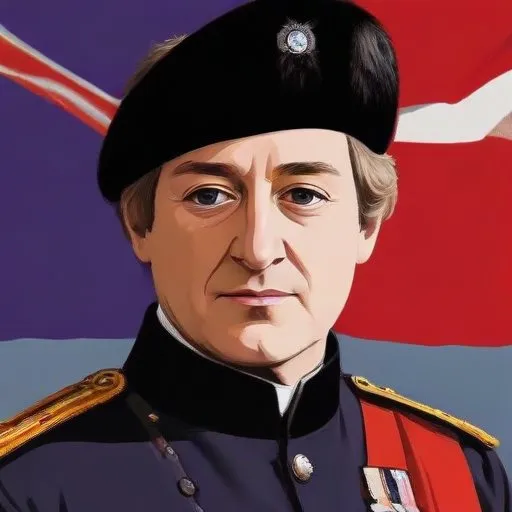
A 17th-century English academic and politician who served as Lord Lieutenant of Radnorshire, known for his involvement in the South Sea Company and his patronage of the arts. He was a prominent figure in his time, supporting notable artists and architects.
James Brydges, 1st Duke of Chandos, is remembered as a prominent English landowner, politician, and member of the peerage who made significant contributions to British politics during the late 17th and early 18th centuries. As a member of the House of Commons and later the House of Lords, he played a crucial role in shaping the country's politics, economy, and society.
Brydges was born on January 6, 1673, at Dewsall, Herefordshire, as the fourth but eldest surviving son of James Brydges, 8th Baron Chandos, and his wife Elizabeth Barnard. He received his education at Westminster School in 1686 and later at New College, Oxford, from 1690 to 1692. He furthered his studies at the Wolfenbüttel academy from 1692 to 1694, where he was elected to the Royal Society in 1694.
Brydges' political career spanned over three decades, during which he held various prominent positions. He was a Freeman of Ludlow in 1697 and was returned unopposed as Member of Parliament for Hereford at the 1698 English general election. He later became a member of the Old East India Company in 1700 and held positions such as Commissioner of public accounts and member of the council of the Lord High Admiral. In 1705, he was appointed paymaster-general of the forces abroad during the War of the Spanish Succession.
In 1714, Brydges succeeded his father as Baron Chandos and vacated his seat in the House of Commons to take his place in the House of Lords. He was subsequently created Earl of Carnarvon in 1719 and finally, Duke of Chandos in the same year. Throughout his life, he was known for his philanthropic efforts, particularly in the field of education. He founded the hospital of St. John the Baptist in 1720, which later became the Chandos Hospital.
James Brydges, 1st Duke of Chandos, left an indelible mark on British history. His contributions to politics, economy, and society continue to inspire future generations. His legacy is a testament to his unwavering commitment to public service and his dedication to the betterment of his country.
James Brydges, 1st Duke of Chandos, lived during a time of great change and upheaval in British history. His life and career spanned the late 17th and early 18th centuries, a period marked by significant political, economic, and social transformations. Despite the challenges he faced, Brydges remained a steadfast advocate for his country and its people, leaving behind a legacy that continues to inspire and educate future generations.
Born in 1667
A witty wordsmith who penned scathing social commentaries, including the iconic "Gulliver's Travels", which continue to delight and provoke readers to this day.
82 Years Old
A German-Canadian singer-songwriter, guitarist, and producer, known for his eclectic style blending rock, folk, and blues, and as the frontman of the rock band Steppenwolf. He's famous for hits like "Born to Be Wild" and "Magic Carpet Ride".
Born in 1672
A renowned 18th-century writer and statesman who penned influential essays and plays, shaping English literature and politics. He's most famous for his witty, insightful writings in The Spectator magazine.
Born in 1672
A pioneering journalist and playwright who co-founded The Tatler and The Spectator, influential publications that shaped 18th-century British literature and culture.
Born in 1676
The first Prime Minister of the United Kingdom, serving from 1721 to 1742, known for establishing the office of Prime Minister and setting important precedents for the role. He is also recognized for his skill in managing Parliament and his role in shaping British politics.
