


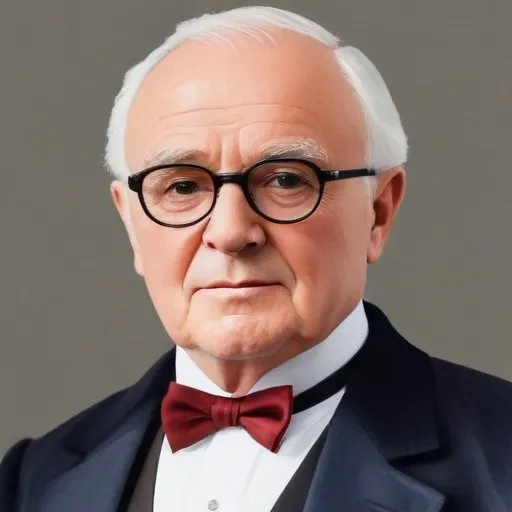
Renowned historian and author, known for his groundbreaking work on the connections between science, technology, and society, making complex ideas accessible to a broad audience.
James Burke, a multifaceted individual with a passion for science, history, and communication, has left an indelible mark on the world of broadcasting and education. Best known for his groundbreaking television series Connections (1978) and The Day the Universe Changed (1985), Burke has been hailed as one of the most intriguing minds in the Western world by The Washington Post.
Born on December 22, 1936, in Derry, Northern Ireland, Burke's academic pursuits took him to Maidstone Grammar School and eventually to Jesus College, Oxford, where he earned his BA and MA degrees in Middle English. Following his graduation, he spent time in Italy, lecturing at the British School in Bologna and the University of Urbino, and later became the headmaster of the English School in Rome.
Burke's entry into the world of television was nothing short of serendipitous. While riding a bus in Rome, he stumbled upon an advertisement for a reporter position at Granada Television's local bureau. On a whim, he decided to apply, and soon found himself reporting on the Mafia in Sicily. This chance encounter marked the beginning of Burke's illustrious career in television.
In 1966, Burke joined the BBC's Science and Features Department, where he became a regular host on the popular science series Tomorrows World. His unique blend of scientific curiosity and engaging storytelling quickly made him a household name. He went on to present The Burke Special and develop his own brand of educational programming, which sought to make complex scientific concepts accessible to a wider audience.
Burke's magnum opus, Connections, premiered in 1978 and took the world by storm. This innovative series explored the interconnectedness of science, technology, and human history, showcasing Burke's remarkable ability to weave together seemingly disparate threads into a rich tapestry of knowledge. The Day the Universe Changed, which followed in 1985, delved even deeper into the philosophical underpinnings of scientific discovery and its profound impact on human society.
James Burke's influence on modern science communication is immeasurable. His pioneering work has inspired generations of scientists, educators, and broadcasters, paving the way for a more informed and curious public. As a testament to his enduring legacy, Burke continues to be celebrated as a visionary thinker, dedicated to unraveling the mysteries of science and technology for the benefit of humanity.
Throughout his remarkable career, James Burke has left an indelible mark on the world of science communication, inspiring countless individuals to explore the wonders of science and technology. As a testament to his enduring legacy, Burke remains an icon of innovation and intellectual curiosity, continuing to inspire new generations of thinkers and explorers.
86 Years Old
A British politician who served as Lord High Chancellor of Great Britain, known for his conservative views and influential role in shaping the country's justice system. He's a prominent figure in UK politics, particularly during the 1990s and early 2000s.
Born in 1906
A renowned historian and academic who reshaped the understanding of modern European history, particularly World War I and II, through provocative and insightful writings.
Born in 1909
A Latvian-English historian and philosopher who explored the intersection of philosophy, history, and politics, and is renowned for his work on the Enlightenment, liberty, and the nature of humanity.
Born in 1924
A pioneering social historian and activist who reshaped the field of history with his groundbreaking works on the British working class, particularly "The Making of the English Working Class".
Born in 1912
A 17th-century historian who wrote extensively on the English Civil War and its radical movements, offering a Marxist perspective on the era's social and political upheavals.
Born in 1917
A renowned historian and author who wrote extensively on the rise of industrial capitalism and the development of socialist and communist movements in the 19th and 20th centuries. His works provide insightful perspectives on modern history and its complexities.
Born in 1914
A renowned historian and academic who wrote extensively on European history, particularly the Renaissance and Nazi Germany, and was known for his meticulous research and engaging writing style.
Born in 1876
A renowned British historian and academic who wrote extensively on English history, particularly the social and cultural aspects of the 18th and 19th centuries.
