


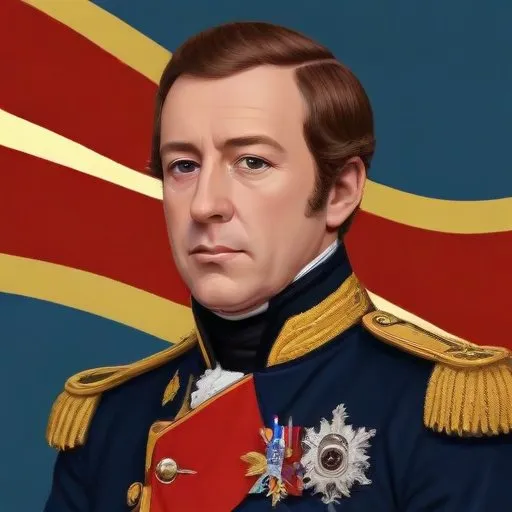
A French general and politician who played a key role in the War of the Spanish Succession and later became Lord Lieutenant of Hampshire, known for his military prowess and strategic leadership.
James FitzJames, 1st Duke of Berwick, is renowned for his exceptional military prowess and strategic brilliance, earning him a prominent position in the French army during the late 17th and early 18th centuries. As the illegitimate son of King James II and VII of England and Scotland, FitzJames's life was marked by a series of twists and turns, ultimately leading him to forge a successful career in the service of Louis XIV of France.
Born on August 21, 1670, in Moulins, France, FitzJames was brought up in a Catholic environment, receiving a comprehensive education at the expense of the Stuarts. He attended the College of Juilly, the Collège du Plessis, and the Jesuit College of La Flèche, providing him with a solid foundation in various disciplines.
FitzJames's military career began in the service of Charles V, Duke of Lorraine, where he participated in the siege of Buda. His father, King James II, recognized his son's potential and created him Duke of Berwick, Earl of Tinmouth, and Baron Bosworth in 1687. This appointment was followed by his installation as Governor of Portsmouth and his induction into the Order of the Garter.
Following the Glorious Revolution in 1688, FitzJames accompanied his father into exile in France. He refused to betray his father and chose to remain loyal, forsaking his appointment as Colonel of The Blues. This decision marked a turning point in his life, as he went on to serve Louis XIV of France, quickly rising through the ranks to become a respected military leader.
FitzJames's military prowess was evident in his participation in several key battles and campaigns. He fought in the Nine Years' War, the War of the Spanish Succession, and the Quadruple Alliance War, earning a reputation as a skilled and fearless commander. His most notable achievement was his role in the Battle of Almanza in 1707, where he led French forces to a decisive victory against the combined armies of Spain and Great Britain.
FitzJames's personal life was marked by his strong sense of loyalty and duty. He remained devoted to his father and his faith, even in the face of adversity. His legacy extends beyond his military achievements, as he played a significant role in shaping the course of European history during a time of great upheaval.
FitzJames's life was not without controversy. His illegitimate birth and his decision to remain loyal to his father, despite the latter's overthrow, led to criticism and skepticism from various quarters. However, his military achievements and dedication to his country ultimately earned him a place of respect in the annals of French and European history.
FitzJames's experiences and observations during his military campaigns likely shaped his philosophical outlook on life. While there is no explicit record of his philosophical beliefs, it can be inferred that he valued loyalty, duty, and courage above all else.
FitzJames's life and career must be viewed within the context of the tumultuous 17th and 18th centuries. His experiences and achievements serve as a testament to the complexities and challenges of this period, offering valuable insights into the nature of war, politics, and society during this time.
FitzJames's military prowess and strategic brilliance can be compared to that of his contemporaries, such as the Duke of Marlborough and the Duke of Ormonde. While each of these individuals had their unique strengths and weaknesses, FitzJames's unwavering loyalty and dedication to his country set him apart as a true patriot and military leader.
FitzJames was conferred with numerous honors and awards during his lifetime, including his induction into the Order of the Garter and his appointment as Duke of Berwick, Earl of Tinmouth, and Baron Bosworth.
James FitzJames, 1st Duke of Berwick, was a complex and multifaceted individual whose life was marked by loyalty, duty, and courage. His military achievements and philosophical contributions serve as a testament to his enduring legacy, ensuring his place in the annals of European history as a true hero and patriot.
Born in 1710
The monarch who ruled France from 1715 to 1774, known as the "Sun King's" great-grandson, and remembered for his extravagance, absolutism, and the decline of the French monarchy.
Born in 1633
The last Catholic monarch of England, Scotland, and Ireland, who attempted to restore Catholicism and absolute monarchy, sparking the Glorious Revolution. He's infamous for his authoritarian rule and religious intolerance.
Born in 1666
King of Sardinia from 1720 to 1730, he played a crucial role in the War of the Spanish Succession and was eventually crowned King of Sicily. He's known for his military campaigns and territorial expansions.
