


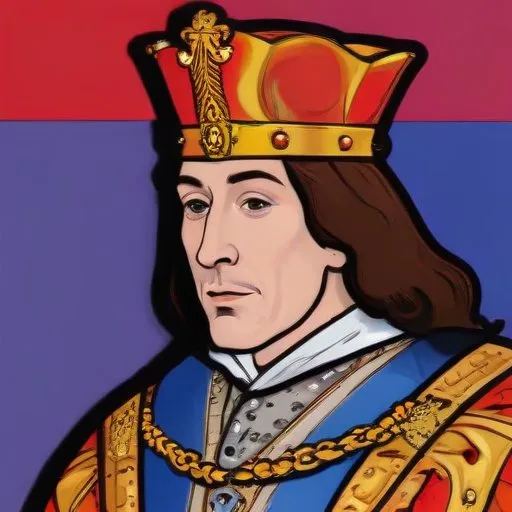
The King of Scots who ruled from 1460 to 1488, known for his attempts to centralize power and his tragic death at the Battle of Sauchieburn.
James III of Scotland, who ruled from 1460 until his death in 1488, is infamous for his ineffective and unpopular governance, marked by unrealistic schemes to invade foreign territories and a penchant for lowborn favorites. Despite this, he is also remembered for his artistic patronage, which, although slight compared to his successors, left a lasting impact on Scotland's cultural scene.
Born on July 10, 1451, James III inherited the throne as a child following the death of his father, King James II, at the siege of Roxburgh Castle. For nearly a decade, Scotland was governed by a series of regents and factions who struggled for possession of the young king, leading to a tumultuous start to his reign.
In 1469, James III began his personal rule, which was marked by controversy and criticism from contemporaries and later chroniclers. He was accused of debasing the coinage, hoarding money, failing to resolve feuds and enforce criminal justice, and pursuing an unpopular policy of alliance with England. His preference for lowborn favorites at court and in government alienated many of his bishops and nobles, as well as members of his own family, leading to tense relationships with his brothers, his wife, and his heir.
One of James III's most notable achievements was acquiring Orkney and Shetland through his marriage to Margaret of Denmark, which saw Scotland reach its greatest territorial extent. However, this was overshadowed by his failed attempts to invade or take possession of Brittany, Guelders, and Saintonge, which were deemed unrealistic and costly by his contemporaries.
In 1482, James's brother, Alexander, Duke of Albany, attempted to usurp the throne with the aid of an invading English army, leading to the loss of Berwick-upon-Tweed and a coup by a group of nobles. James was imprisoned for a time before being restored to power.
Despite his reputation as Scotland's first Renaissance monarch being somewhat exaggerated, James III did leave a slight but significant artistic legacy. He patronized painters and musicians, and his coins displayed realistic portraits of the king. The Trinity Altarpiece and the King's Chapel at Restalrig are also notable examples of his cultural contributions.
James III's reign was marked by controversy and instability, and his reputation as a king has been largely negative. However, his artistic patronage and territorial expansion have left a lasting impact on Scotland's cultural and historical landscape.
While James III may not have been the most effective or popular king, his reign remains an important chapter in Scotland's history, marked by both controversy and cultural contributions.
Born in 1473
The King of Scotland who united the country, strengthened its economy, and patronized the arts, earning him a reputation as a wise and cultured ruler.
Born in 1473
The King of Scotland who united the country, strengthened its economy, and patronized the arts, earning him a reputation as a wise and cultured ruler.
Born in 1274
Led Scotland during the First War of Scottish Independence, ultimately securing a decisive victory at the Battle of Bannockburn and earning recognition as the country's rightful king. He's celebrated for his bravery, strategic thinking, and unwavering commitment to Scottish freedom.
Born in 1324
King of Scotland from 1329 to 1371, known for his role in the Second War of Scottish Independence and his attempts to strengthen the Scottish monarchy.
Born in 1316
First King of the House of Stewart, ruling Scotland from 1371 to 1390, known for establishing a strong and stable monarchy.
Born in 1198
King of Scotland from 1214 to 1249, known for re-establishing Scottish independence and expanding the kingdom's borders through military campaigns and strategic marriages.
Born in 1489
Daughter of an English king, she married a Scottish king, uniting the thrones and paving the way for the eventual union of the crowns. She played a key role in Scottish politics and cultural development.
