


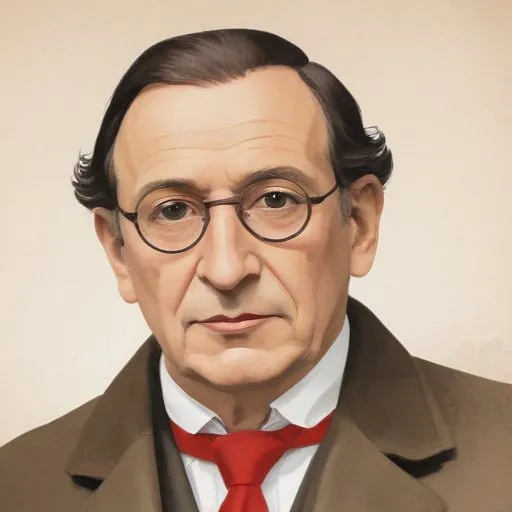
A pioneering economist and social reformer who predicted the devastating consequences of modern warfare and advocated for international cooperation and disarmament.
Jan Gotlib Bloch, a Polish banker and railway financier, is renowned for his groundbreaking research on modern industrial warfare, which led him to conclude that war had become economically and morally obsolete in the modern era. His seminal work, "Future War and its Economic Consequences," published in 1898, is a testament to his prophetic vision and his commitment to promoting peace and international cooperation.
Born on July 24, 1836, in Radom, Poland, Bloch was raised in a Jewish family that later converted to Calvinism. Despite facing antisemitic policies in the Tsarist government, Bloch remained committed to his heritage and was sympathetic to the Zionist movement. He pursued his education at the University of Berlin, where he developed a keen interest in finance and economics.
Bloch's career in finance took him to Warsaw, where he worked at a local bank, and later to St. Petersburg, the capital of the Russian Empire. It was in St. Petersburg that he became involved in the development of the Russian Railways, financing new railway construction and writing research papers on the subject. He went on to found several banking, credit, and insurance companies, cementing his reputation as a shrewd businessman and financier.
Bloch's fascination with modern warfare was sparked by the Franco-Prussian War of 1870-1871, which highlighted the devastating consequences of industrialized warfare. He was convinced that the old methods of warfare were obsolete and that new technologies had rendered war economically and morally unsustainable.
His research led him to conclude that modern warfare would result in unprecedented destruction, loss of life, and economic devastation. He also predicted the rise of trench warfare, the importance of logistics, and the role of civilians in modern conflicts. Bloch's work was ahead of its time, and his predictions would later be borne out by the horrors of World War I.
Bloch's work was recognized by the Russian government, which appointed him a member of the Russian Finance Ministry's Scientific Committee in 1877. He was also awarded the Order of St. Stanislaus, a high honor bestowed by the Russian Empire.
Bloch married Emilia Julia Kronenberg, a member of a prominent Polish banking family. The couple had a close relationship, and Bloch's wife supported his research and writing throughout his life.
Jan Gotlib Bloch passed away on January 7, 1902, leaving behind a legacy of groundbreaking research and a vision for a more peaceful world. His work continues to inspire scholars, policymakers, and pacifists around the world, serving as a testament to the power of human imagination and the importance of promoting international cooperation and understanding.
Bloch's work was published at a time when Europe was on the brink of war. His predictions about the devastating consequences of modern warfare were dismissed by many as alarmist, but his work would later be vindicated by the horrors of World War I. Today, Bloch is recognized as a pioneer in the field of modern warfare studies, and his work continues to influence scholars, policymakers, and military strategists around the world.
Born in 1828
A Russian literary giant who penned sweeping novels like "War and Peace" and "Anna Karenina", exploring the human condition with profound insight and masterful storytelling.
Born in 1821
A Russian literary mastermind who penned psychologically complex novels that probed the human condition, exploring themes of morality, philosophy, and the darker aspects of human nature.
Born in 1870
Founder of the world's first socialist state, leading the Bolshevik Revolution and establishing the Soviet Union, known for his radical Marxist ideology and authoritarian rule.
Born in 1856
A Russian philosopher and theorist who developed Marxist theory and was a key figure in the Russian Revolution, known for his writings on dialectical materialism.
Born in 1871
A pioneering Marxist theorist and activist who advocated for workers' rights and criticized capitalism, known for her radical ideas on revolution and democracy.
